
By Lola Carlton
“So Where Did You Grow Up?”
In the state of modern politics, the American class system is only too obvious. As a matter of fact, it’s so glaringly obvious that we often forget that Australia has a deeply rooted class system of its own. Imported directly from the UK through colonisation, if you want any luck in ascending the class hierarchy in modern day Australia, there’s a collection of things that must be embraced. And, there’s certain ugly parts of one’s upbringing that must be cut out like parasites. It is this conversation The Social Ladder has with its audience. A deeply intimate and highly local reflection, The Social Ladder doesn’t just ask why someone would ever want to climb the ranks, it explores the sheer ridiculousness of how those delicate attempts must be made - and how easy they are to screw up.
The stage at the beginning seems confusingly bare. Ensemble is known somewhat for their flashy production value, so having a completely bare experience was almost out of character. We shouldn’t have worried, however. In a brilliantly staged foundation for the entire two hour experience, three lamps drop slowly from the ceiling, each representing the three layers of the Australian class system; working, middle, and ruling.
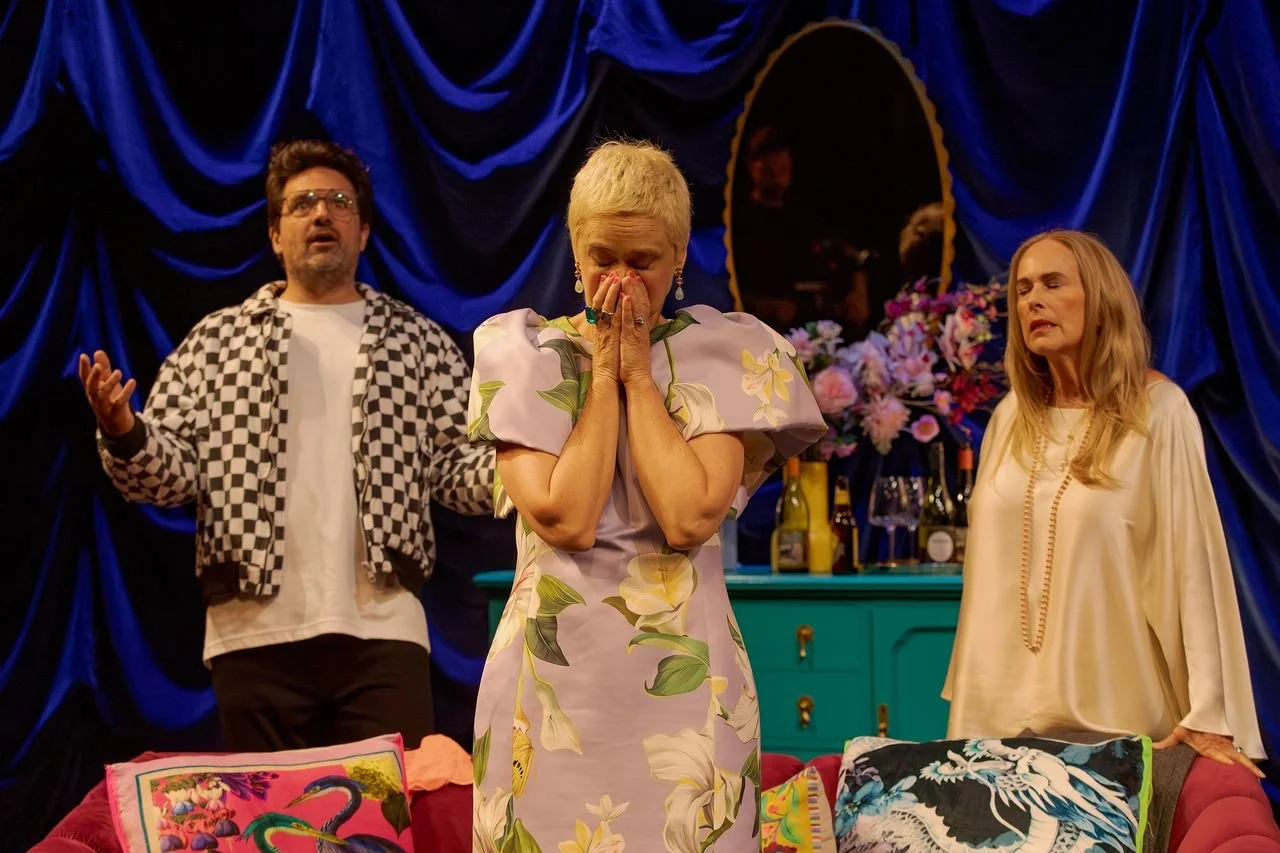
Williamson’s script has a knack for helping his audience feel right at home, and the comedy of the show certainly embraced calling to cultural references that allowed us to both laugh and interrogate the conversations happening on stage. Too often when a production comes to Sydney, or a script is adapted for Sydney stages, we the audience end up missing out on those finer points of context simply because we haven’t grown up with them. The Social Ladder cleverly evades this problem, and in doing so, allows the production to have the same conversation theatre has had before in a much more nuanced way. This nuance continues with the production design elements as the show evolves. Mandy Bishop as Katie Malloy is constantly in costumes that feel almost too chic, performing taste rather than embodying it. The couple’s house in the second act also ends up feeling more like an art museum than a residence, further separating them from the lived in luxury the Mallory’s exist in.
Mandy Bishop puts up an incredibly strong performance as the epitome of the social climber middle class Australian experience. Both a brilliant comedic performer and with strong character instincts, she is both deeply unlikable for the working class folks in the room, and uncomfortably understandable. A particularly memorable moment for me in this regard was the brilliantly tight expression she wore for the first 15 minutes of her stage time. Her chemistry on stage was distinctly marked by the reality she knew, they knew, and we knew that she was using them. Despite this, I found myself still wanting her to succeed. And although perhaps her character didn’t quite learn anything from her ending, quietly, I didn’t want her to. Katie Norrie is the distilled representation of the provincial Australian insecurity we’ve carried since the First Fleet, and her value system is so baked into Australian Culture, if she had changed “for the better” by the end, it would’ve been unsatisfying. Instead, Bishop’s performance allowed us to giggle at her depravity and unraveling, whilst also pointing the mirror back at us, and making us all a little uncomfortable as we left the theatre. Wondering if we were also that annoying.
My stand out of the night was Jo Downing as Laura Gregory: a working class school teacher married to an impotent creative. Downing both had incredibly strong comedic instincts and understanding of tempo, but she also fully understood the stakes in a way that made her performance ever evolving and interesting. Laura Gregory the character understands why the things in this No Exit-Esque dinner party are happening the way they are, and Downing in response finds both the dry absurdist humour of that understanding, and the quiet horror of knowing that everyone around you is using your work and talent whilst simultaneously being completely willing to abandon you at the drop of a hat. Beautifully expressive and deeply likeable, she represented maybe the closest thing to an innocent character this play had to offer.
The Malloys, in contrast, functioned more like characters out of a Pinter play. Both Sarah Chadwick and Andrew McFarlane delivered incredibly sophisticated performances - a direct quote from my notebook being “I love to see a well trained actor.” Both of them represented the Australian upper class, McFarlane as the true-blue Aussie Conservative, and Chadwick as the English transplant, better than everyone just by being from the original family house rather than the granny-flat. Their on-stage chemistry was fascinating, an odd mix of desire and disdain all mixed up in the knowledge they needed one another to stay in power. Sarah Chadwick continued to impress as her character gained nuance towards the end of the piece, yet still remained impassive and untouchable, never fully in reach of the Norries, and certainly not available to the Gregorys.
Johnny Nasser and Matt Minto gave entertaining performances, and although they had great chemistry with the other actors on stage, struggled to offer their characters the nuance that the women on stage had - as well as perhaps jumping too quickly on the punchline which undercut some moments of comedy. They were, however, both strong comedic performers, and as their friendship was tested by their mutual betrayal, their ability to switch loyalties depending on who was on the winning side was an impressive example of their emotional intelligence. All three men on stage created fascinating examples of widespread conservative, centrist and leftist arguments - and more interestingly, that the people behind those arguments, no matter how flattering they might sound, were often hiding a weak moral backbone behind masculine posturing.
Across the board, this cast produced some truly remarkable performances. All six had excellent vocal technique and comedic ability, making this show’s two hour run time fly by. The stage work, script, production value and tech all elevated the performances three-fold and brought us into an uncomfortably relatable world. This is in no small terms a professional show done by God’s honest professional people. If you’re looking for a hilarious and pointed dissection of high-society Australian culture, you’ve found one. Although you may cringe and grit your teeth the entire way through.