
By Aden Zaki
Photo Credit Neil Bennett
When staging a play like this, written in such a particular moment, to deliver such a particular message, for such a particular audience, the question of relevancy becomes unavoidable. It is a testament to Larry Kramer’s writing – and perhaps an indictment of the culture he was critiquing – that many of the questions it asks remain unresolved and urgent today. Kramer’s tragic, semi-autobiographical portrait of the AIDS epidemic is stylishly revived by the STC, thirty-six years after they first staged it in 1989. The production takes few risks, but the potent material is served by this simplicity.
It is New York City in the early 1980s. A group of gay men fight to establish an advocacy group poised against a mysterious and fatal disease decimating their community. Although officially led by Bruce Niles (Tim Draxl), an investment banker whose squeaky-clean image provides a marketable face for the movement, the operation is spearheaded by writer turned activist Ned Weeks (STC Artistic Director, Mitchell Butel). As the death count rises, the plot is driven by Ned’s unrelenting commitment to his cause, which rubs both his opponents and allies the wrong way.
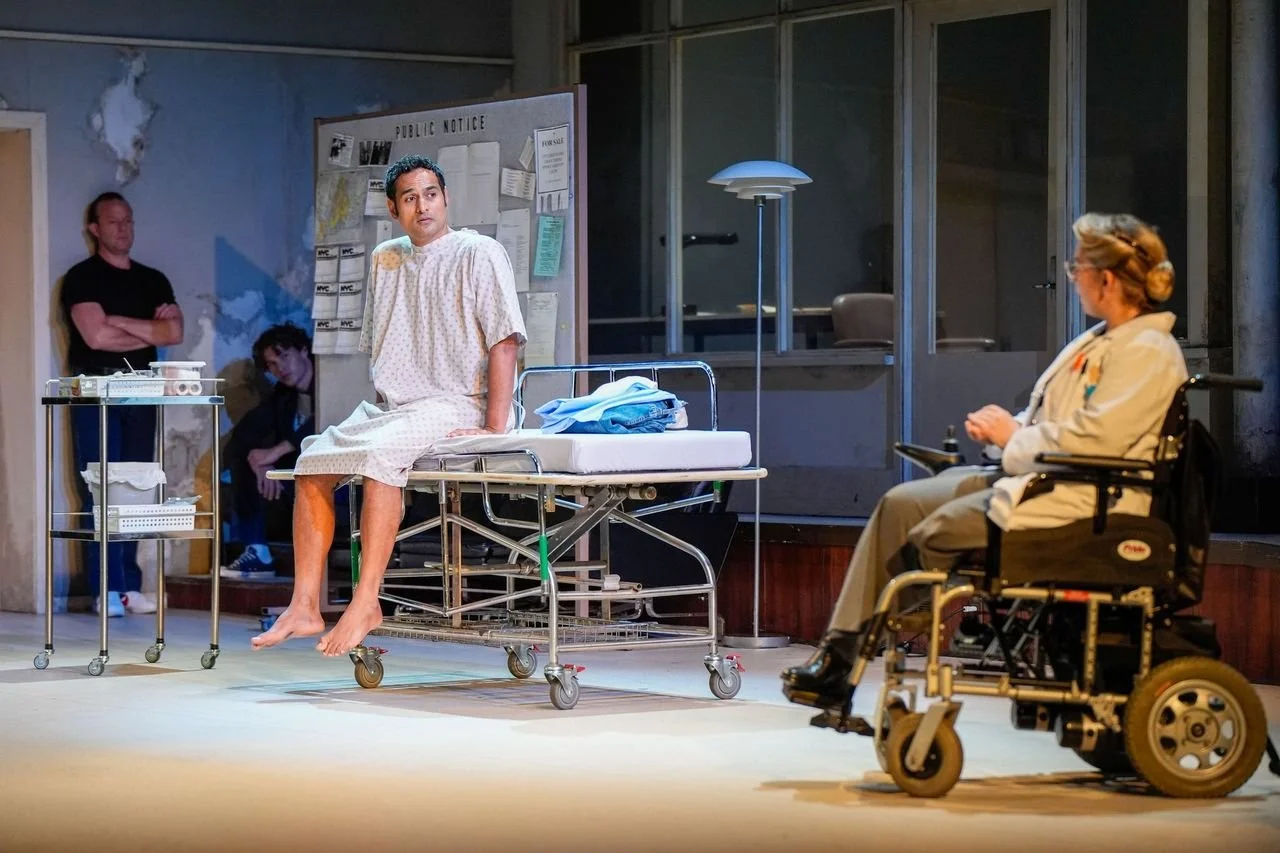
This is especially true of his attempts to spread the advice of Dr Brookner (Emma Jones), the only medical professional taking the epidemic seriously, who warns that to curb the spread gay men need to stop having sex. But then… what are they supposed to do? It’s an idea that offends both the conservative and liberal sects of their grassroots organisation. Ned’s ensuing conflict with both sides opens up questions about how gay men relate to each other beyond their sexuality, questions especially relevant to our post-Sexual Revolution moment, where promiscuity is no longer an expression of a radical politic but a kind of hegemony. At times the play comes across as didactic in its critique of promiscuity, but there is enough counterpoint to keep things tonic. In Evan Lever’s monologue as Mickey Marcus, he recalls embracing his desires and overcoming shame as an instrumental step in his political journey. Is sex worth dying for? Maybe not. But freedom and love certainly are, which is what sex has come to represent to a community for whom it has been denied and repressed.
Steadfast at the centre of these conflicts, Ned is insufferable to almost everyone he knows. Everyone, that is, except his lover Felix Turner (Nicholas Brown), a suave but politically neutered reporter for the New York Times. Their relationship is charming and tragic, but the most emotionally impactful scenes play out between Ned and his brother, Ben (Mark Saturno). This is due to both Saturno’s portrayal of Ben’s tragic ignorance and Butel's indicting monologue, the height of his performance. It’s a shame the resolution of their conflict comes so suddenly, as an almost perfunctory ornament to the final scene.
On the whole, the production is top class – one would expect nothing less from the STC. It does little, however, to elevate the material.
Although I found Jeremy Allen’s set initially disorienting – something like a hospital ward crossed with a dingy bohemian apartment – it grew on me. The action grounds the space and brings it to life. So too does Nigel Levings’ naturalistic lighting, streaming in through windows from side stage. By the end, my only wish was that they had made better use of such an interesting set, as much of the action was confined to the centre platform.
Michael Griffiths and Rowena Macneish, on piano and cello respectively, sit at the fringes of this stage. Hilary Kleinig’s accompaniment is stylish and minimalistic. It successfully carries the momentum through blackout transitions and underscores emotional beats. Occasionally the duo are joined by vocal performances from the cast, who loiter around the edges of the stage too, awaiting their next scene. The vocals are sharp, but the evenly compressed three part harmonies are almost too clean for their surroundings, which might have suited a more raw performance.
Keeping the cast on stage to watch the plot unfold with us is perhaps the most interesting of Dean Bryant’s directorial decisions. The play is divided between the struggle of one man and the horror his community is facing. The physical presence of this community on stage draws focus to the collective mourning. It also prevents the scenes of terrible suffering from feeling voyeuristic. You get the real sense of a whole community in reeling, one whose fate you have been invited to participate in, not merely to witness.
During intermission there was a sense of solidarity among the audience, who filed into the foyer with gentle pats on the back and hugs and reminiscences. After the curtains were drawn, a neighbouring couple told us about their experience of the crisis. One of them had seen the first STC production back in 1989. He said the play felt much more polemical back then, which I imagine I’d agree with. Perhaps some distance from the political moment of its conception has given the show room to breathe, allowing it to speak on issues which, although less fatal than the AIDS crisis, are nonetheless endemic.