
By Faye Tang
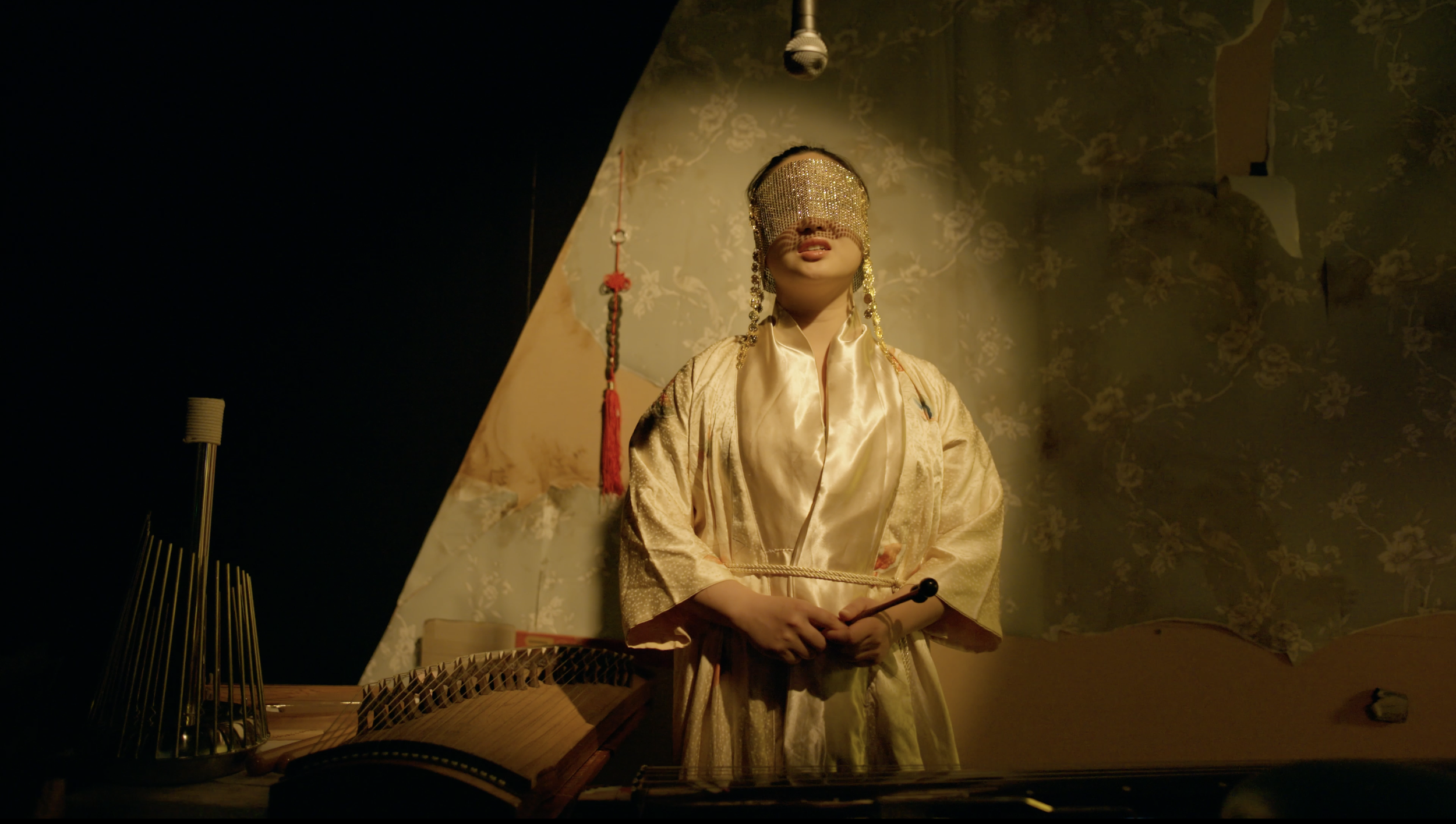
A Chinese Christmas opens on a scene of intentional bathos. A musician masked in jewels, whom we later come to know as Lady Dai (a Chinese noblewoman known for being a well-preserved mummy), plucks the guzheng and presents an impressive arsenal of instruments, both traditional Chinese and makeshift. The music is mystical, impressionistic, composed and played by Jolin Jiang who, in her silk robe and shimmering headdress, informs the audience that “Heepa is coming”. We sit in a tense silence, waiting for Heepa—who, eventually, bundles himself onto the stage, in a tee and shorts and silly socks, whooping with Zillenial glee.
The setup is playfully metatextual. Audience members filling both sides of the KXT, clad in Christmassy tees and sneakers, become Heepa’s (un)dead Chinese ancestors. Lady Dai lectures Heepa about xiao, filial piety, but when Heepa provokes us, it’s we the ancestors that sit in respectful silence. Mostly, Heepa’s conversation partners are himself and the props, and what an array of them! Despite the stage being so cluttered, almost past the point of homeliness, writer-actor Trent Foo’s expertly physical, endearing performance, along with Cat Mai’s clever lighting design, constantly make and remake vivid scenes.
Memories, also, are made and remade. Heepa’s traipse in the underworld isn’t just a showy retelling of a childhood caught between cultures, but also a plea, for the ancestors to work our magic and convince his unflappable grandmother Paw Paw, with whom he’s “beefing”, to come to his Christmas party. As Lady Dai takes Heepa through flashbacks to his core memories, he starts to realise that things didn’t always happen the way he thought they had. Paw Paw is always kinder than he’d imagined, more understanding. “It didn’t happen like that,” Heepa says, grappling with his own interpretation. “Paw Paw was angrier… wasn't she?”
Foo’s humour hits home for those in the know, littered with references to diaspora life and passing quips about the formidable Wu Zetian, first and only female Emperor of China, hilariously implied to be a relative of Heepa’s. Tiang Lim, as Paw Paw, also gave an incredible performance. She’s well-accented, loud and cantankerous, phrases in Mandarin and Cantonese flying from her mouth to reprimand her naughty grandson.
And though Heepa himself didn’t go to Chinese school, anybody who did will be floored by his rendition of the Tang-era poem recited so often by reluctant Chinese diaspora children and struggling Chinese-learners that it’s become something of an institution in itself: Li Bai’s 静夜思 (Jìngyè sī). The poem’s last line, which roughly translates to “I lower my head and think of home”, delivered with tenderness by Foo, struck a chord with the play’s reflections on that aspect of home which Heepa has fought to understand—his Chinese family and culture.
Heepa’s unreliability lets plot twists unfurl in a satisfying, expert way; they aren’t so absurd or abrupt as to break the suspension of disbelief, but are cued in subtly, realisation dawning on the audience only when it’s too late to stop the tears. For anybody hungering after a sweet and teary Christmas romp, and especially for those reconciling two or more cultural backgrounds, A Chinese Christmas will touch you to the core and remind you to say “I love you”—even if it’s not something your family ‘does’.
A Chinese Christmas is playing at KXT Broadway until 20 December.