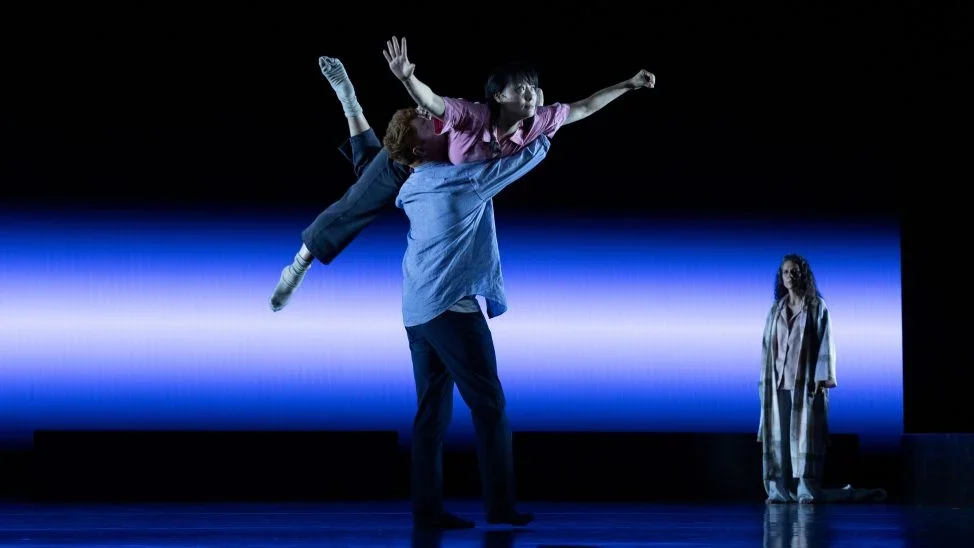
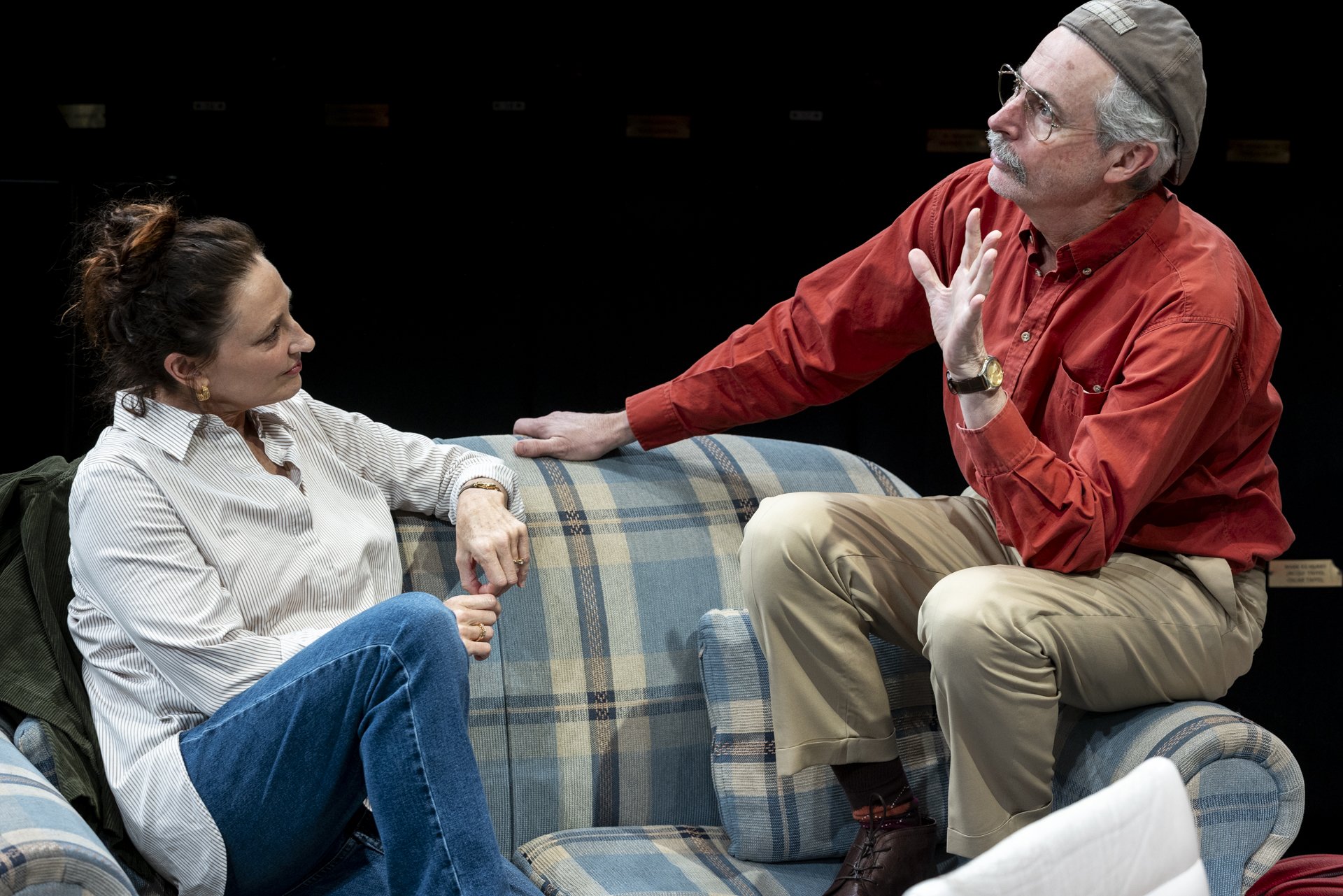
2025

A Chinese Christmas: KXT on Broadway

By Faye Tang

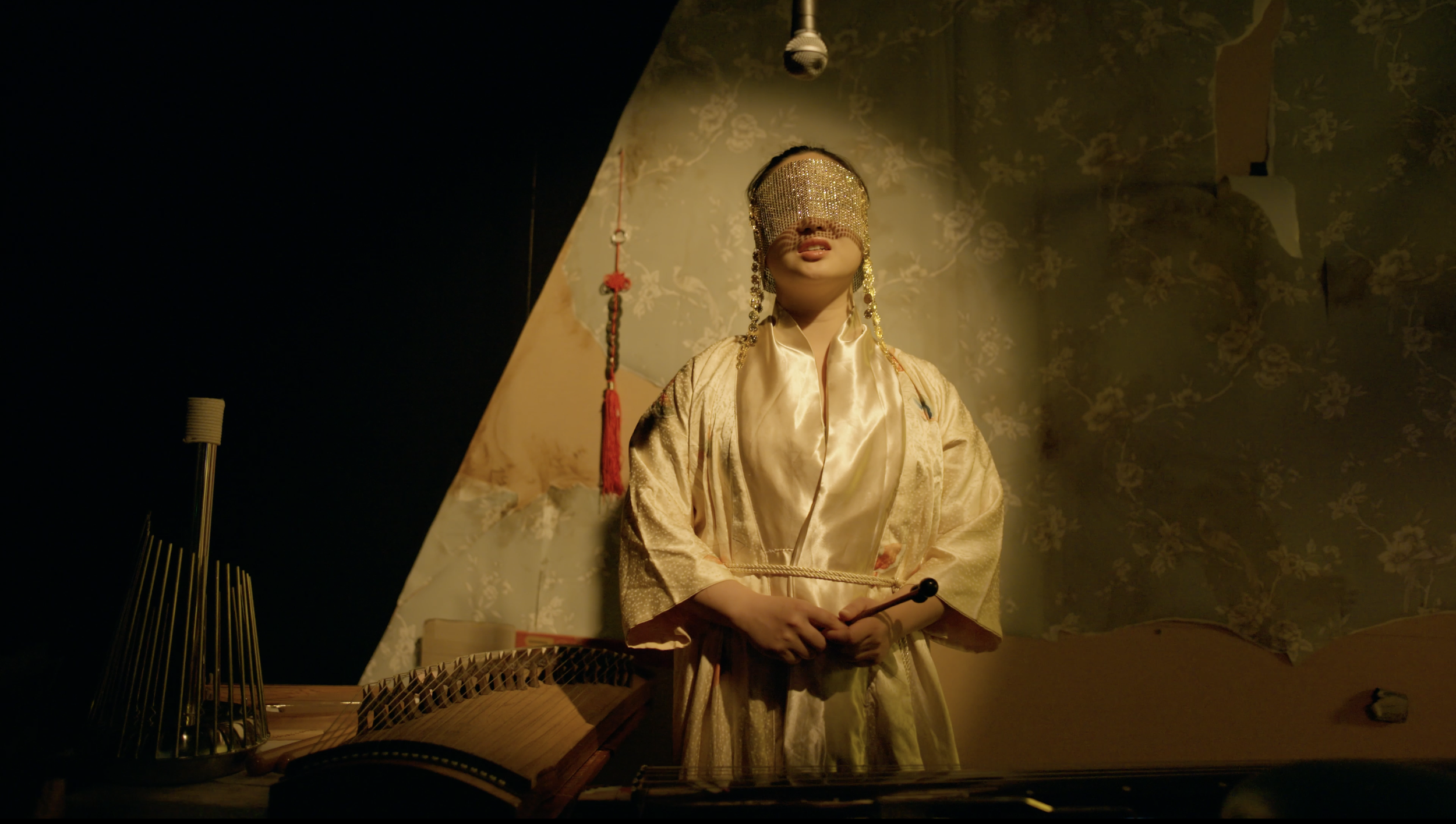
A Chinese Christmas opens on a scene of intentional bathos. A musician masked in jewels, whom we later come to know as Lady Dai (a Chinese noblewoman known for being a well-preserved mummy), plucks the guzheng and presents an impressive arsenal of instruments, both traditional Chinese and makeshift. The music is mystical, impressionistic, composed and played by Jolin Jiang who, in her silk robe and shimmering headdress, informs the audience that “Heepa is coming”. We sit in a tense silence, waiting for Heepa—who, eventually, bundles himself onto the stage, in a tee and shorts and silly socks, whooping with Zillenial glee. 

The setup is playfully metatextual. Audience members filling both sides of the KXT, clad in Christmassy tees and sneakers, become Heepa’s (un)dead Chinese ancestors. Lady Dai lectures Heepa about xiao, filial piety, but when Heepa provokes us, it’s we the ancestors that sit in respectful silence. Mostly, Heepa’s conversation partners are himself and the props, and what an array of them! Despite the stage being so cluttered, almost past the point of homeliness, writer-actor Trent Foo’s expertly physical, endearing performance, along with Cat Mai’s clever lighting design, constantly make and remake vivid scenes.

Memories, also, are made and remade. Heepa’s traipse in the underworld isn’t just a showy retelling of a childhood caught between cultures, but also a plea, for the ancestors to work our magic and convince his unflappable grandmother Paw Paw, with whom he’s “beefing”, to come to his Christmas party. As Lady Dai takes Heepa through flashbacks to his core memories, he starts to realise that things didn’t always happen the way he thought they had. Paw Paw is always kinder than he’d imagined, more understanding. “It didn’t happen like that,” Heepa says, grappling with his own interpretation. “Paw Paw was angrier… wasn't she?”

Foo’s humour hits home for those in the know, littered with references to diaspora life and passing quips about the formidable Wu Zetian, first and only female Emperor of China, hilariously implied to be a relative of Heepa’s. Tiang Lim, as Paw Paw, also gave an incredible performance. She’s well-accented, loud and cantankerous, phrases in Mandarin and Cantonese flying from her mouth to reprimand her naughty grandson.

And though Heepa himself didn’t go to Chinese school, anybody who did will be floored by his rendition of the Tang-era poem recited so often by reluctant Chinese diaspora children and struggling Chinese-learners that it’s become something of an institution in itself: Li Bai’s 静夜思 (Jìngyè sī). The poem’s last line, which roughly translates to “I lower my head and think of home”, delivered with tenderness by Foo, struck a chord with the play’s reflections on that aspect of home which Heepa has fought to understand—his Chinese family and culture.

Heepa’s unreliability lets plot twists unfurl in a satisfying, expert way; they aren’t so absurd or abrupt as to break the suspension of disbelief, but are cued in subtly, realisation dawning on the audience only when it’s too late to stop the tears. For anybody hungering after a sweet and teary Christmas romp, and especially for those reconciling two or more cultural backgrounds, A Chinese Christmas will touch you to the core and remind you to say “I love you”—even if it’s not something your family ‘does’.

A Chinese Christmas is playing at KXT Broadway until 20 December.

Irving Berlin’s Holiday Inn: Riverside Theatres Paramatta

By Aidan Hale

It’s that time of year again. Christmas lights are up, beaches are packed, and everybody is just about fed up with work and exams. It’s the holiday season, and what better way to spend it then by watching an all holiday-themed musical?

Well, ‘Irving Berlin’s Holiday Inn’ at Riverside Theatres Paramatta will be sure to scratch that holiday itch. The musical by Chad Hodge and Gordon Greenberg adapts Berlin’s original 1942 screenplay, and with it all the caustic charm and spirited sincerity of classic American 90’s romcoms.

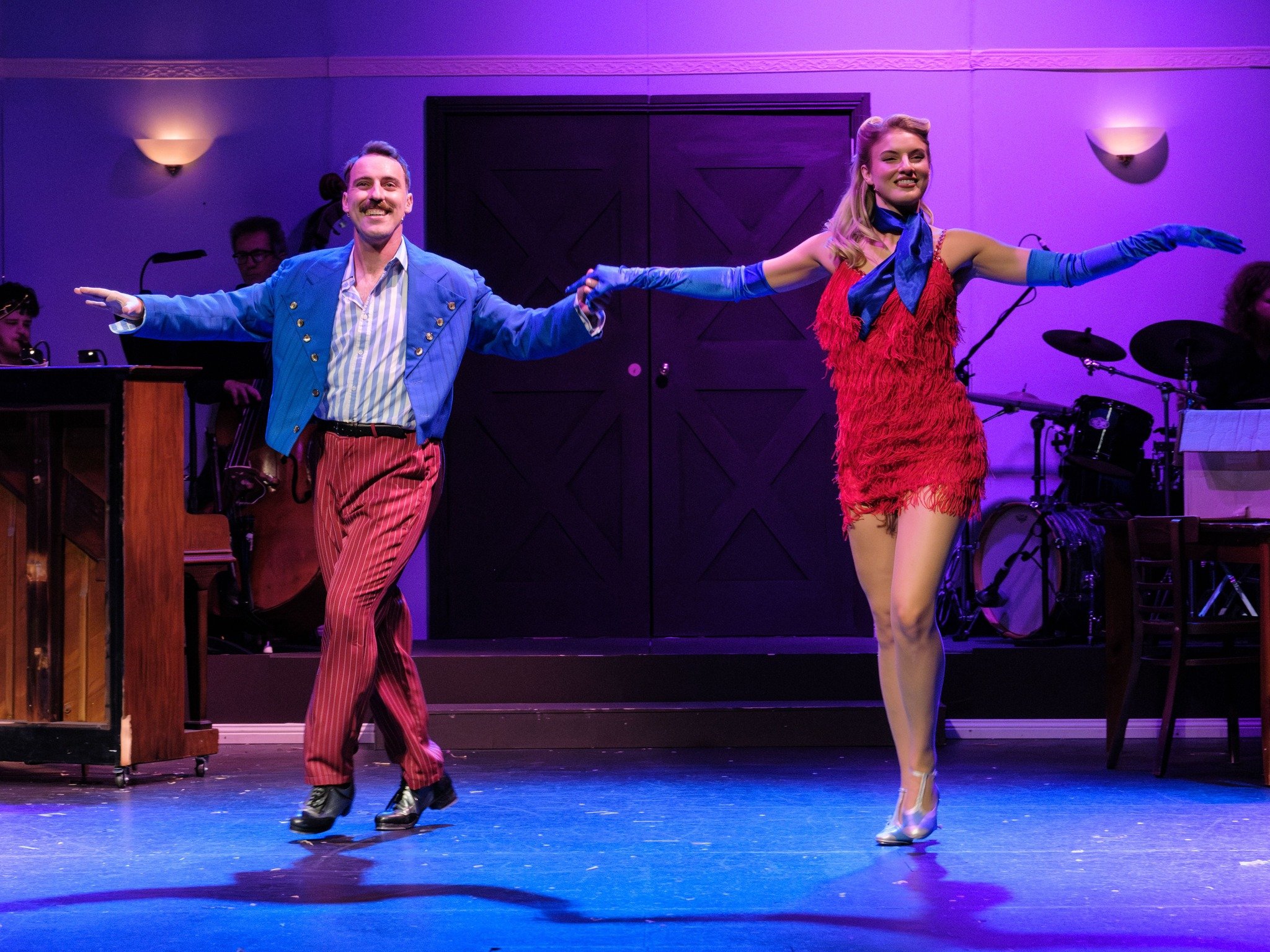
You’ve seen this story a hundred times: two men fight for the love of one woman. Singer Jim Hardy (Rob Mallett) is the loveable straight-man set on building a quiet and peaceful life; the other, dancer Ted Hanover (Max Patterson), is the sly and (somewhat) sleazy rival who wants to make it Hollywood big. This time though, our love story is set at the titular Holiday Inn, a farm bought by Jim in Connecticut where music and dance ensue only on, you guessed it, the holidays! At the Holiday Inn, love blooms between Jim and previous owner Linda Mason (Mary McCorry), which is then complicated when Ted pushes Linda to become his new dance partner.

The adapted script is certainly not going to blow you away. It’s the kind of love story that’s become the run-of-the-mill: containing the same thousand romcom tropes coupled with weird pacing and structure (the Holiday Inn isn’t established until just before the second act!). A classic or not, the script is a bit of a dud.

However, what will get you smiling and clapping is director Sally Dashwood’s keen interest in playing up the melodrama of it all. The production has this cheeky, hilarious, and slightly sardonic self-awareness oozing out: actors conducting the live band faster to mess with the music’s tempo and rhythm, breaking the fourth wall to treat the audience as the in-world patrons of the Holiday Inn, Jim and Ted unknowingly and happily dancing with each other as Linda gets whisked away. These stylised choices demonstrate a great understanding that what will get the audience onboard with this musical is emphasising its playfulness.

Choreographer Veronica Beattie George also understood the assignment. Tap-shoes, canes, jump-rope, the whole ballroom blitz; it’s like a travelling fair came to town and you couldn’t get more playful if you tried. Paired with the capable and talented ensemble, the choreographed dance and swing really elevates the music. On that note, Music Director Dylan Pollard does well to preserve and modernise Berlin’s original lyrics, keeping the catchy tunes while adding a new pep to its step.

A standout musically was McCorry’s Linda Mason, who sung beautifully and often left me in awe of her incredible voice. Performance-wise, Paloma Renouf as New York superstar and Jim’s ex-fiancé, Lila Dixon, was an absolute pleasure to watch. Bombastic, loud, and a little bit ditzy, Renouf plays the showbiz stereotype fantastically. It was always a delight when she was onstage.

And delight is the best word to describe this production. Although I found the musical was full of tired tropes and weird pacing, ‘Irving Berlin’s Holiday Inn’ was seriously just a delight!

Appropriately festive and a jolly good time, ‘Irving Berlin’s Holiday Inn’ is playing at Riverside Theatres Paramatta until December 14th.

Old Fitz Theatre: Born On A Thursday

By Aidan Hale

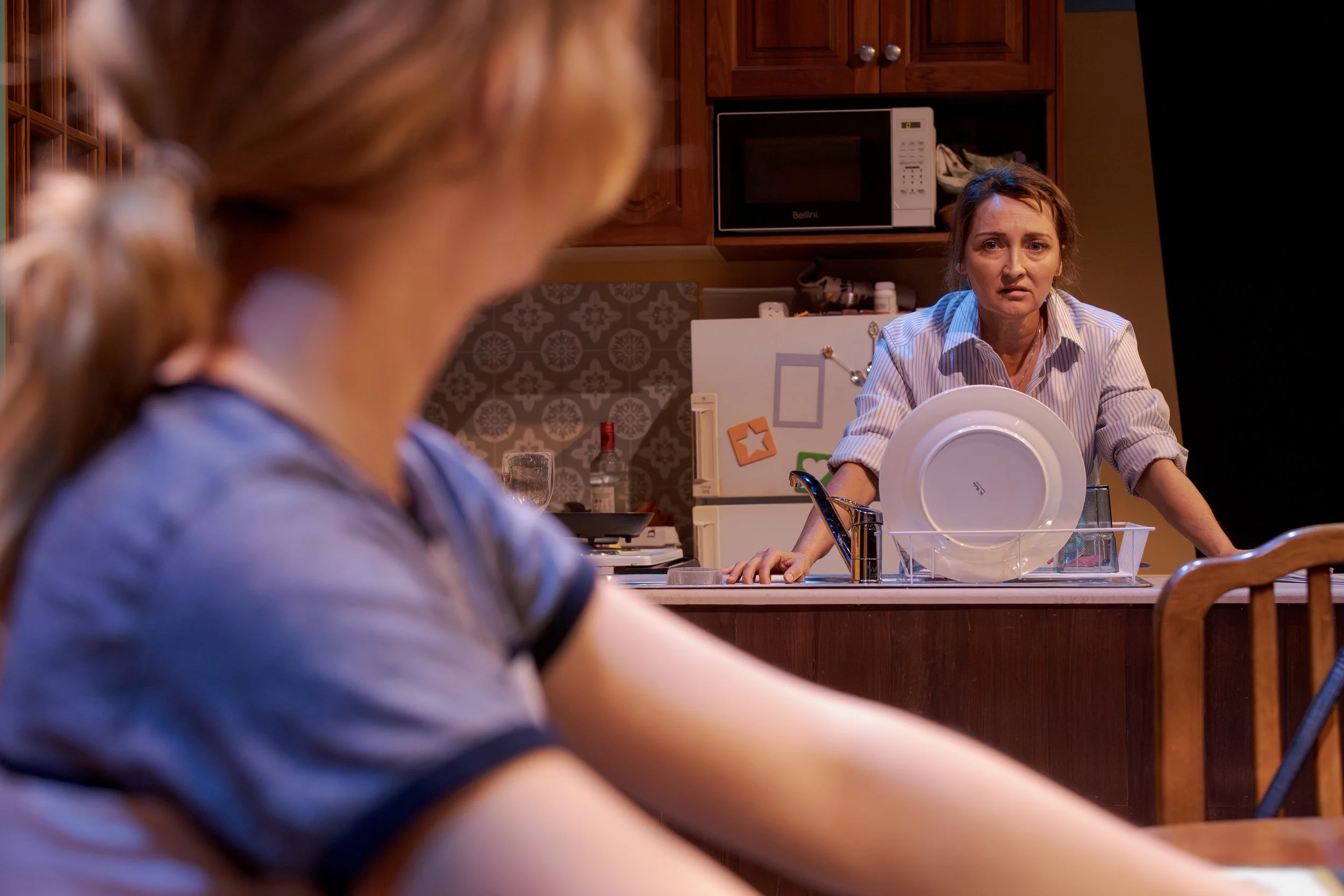
Imagine: the date is 1998, Christmas Eve. Bathed under dim yellow lights, your neighbour is in the kitchen making himself a cuppa. He’s there to tend to your backyard as you get ready for work. He drinks his cuppa, then gets on with it; radio in the backyard to keep him company. This is the most any day gets: quiet, comfy, and a little bit boring––sometimes broken up by the excitement of phone calls mistaking your residence for the butchers. 

While I wasn’t born before the cultural disruption of mobile phones and phishing scams that was the 2000s, Jack Kearney’s new kitchen-sink drama, ‘Born On A Thursday,’ certainly made me feel like I was. Set across a year (more or less) from the end of 1998 through to 1999, Kearney’s witty and heartfelt script deconstructs the familial struggles that we Aussies love to keep unspoken and unheard. 

At the centre of the family struggle is April (Sofia Nolan), as she suddenly returns from her life as a dancer in Denmark and crashes her Sydney home unannounced after 18 months of radio silence. Nolan captures the out-of-sorts eldest daughter of the family well. Often, she acts as the audience surrogate, as keenly interested in tearing open the family’s sealed envelope of her brother Isaac’s (Owen Hasluck) tragic football accident as we are. Her insistence (sometimes a cruel one) in forcing the unspoken to be said is sincere and intense, engaging the audience in the play’s backyard mystery.

As April disrupts the rhythms and traditions rooted in her family, the late 90’s Australian suburbia set constructed by Soham Apte and Angus Nott encapsulates this disruption. Apte and Nott’s set ingeniously tracks the passage of time by the flip of a calendar and changes of the season. A crack in the wall reveals the house’s backyard, where April’s arrival is marked by an unkept garden. Over the course of the play, the garden becomes less unruly as the characters grow accustomed to navigating their family quarrels.

Supporting the family through their quarrels are friends Howard (James Lugton) and Estelle (Deborah Galanos). Lugton plays the affable and caring (perhaps too caring) neighbour, and Galanos the loud and eccentric friend of the mother. The dynamics of both with the family encapsulate what Director Lucy Clements does best. A sharp attention-to-detail given to characters and their small relational idiosyncrasies: vigorous defences when traditions of crossword discussions are challenged, faltering eye contact when Isaac’s football accident is mentioned, and so on.

However, I cannot mention sharp attention-to-detail without also giving my overwhelming praise to Ingrid’s actress Sharon Millerchip. My God, what a performance! Millerchip undeniably elevates this production to soaring heights with her carefully crafted and lived-in performance of an unfaltering mother surviving day-to-day. Closed off and exhausted, yet caring and persistent, Millerchip trims away at the hedges obscuring Ingrid to lay bare her beating heart as she fights fervently for her son to live a normal life.  

As seasons change from summer to winter and the backyard is uprooted, so are the family’s quiet assumptions. At times, this leads to severe challenges: screaming matches, unfair compromises, and for many––their darkest moments. But then winter fades into spring: new roots grow, and the world starts to settle. And once the clouds part and the blue sky is seen, we as the audience are left with something familiar. Something quiet and comfy. And although ‘Born On A Thursday’ at the Old Fitz isn’t grandiose and explosive, it is anything but boring.

‘Born On A Thursday’ is playing at the Old Fitzroy Hotel until December 14th.

Photo Credit: Phil Erbacher

Sydney Theatre Company: The Shiralee

By Sophia Grover

Tough and Tender...

From laughter to tears, love to jaw-dropping twists, Sydney Theatre Company’s new adaptation of D’Arcy Niland’s “The Shiralee” delivers it all. Directed by Jessica Arthur, this production transforms the well-known Australian novel into a poetic and deeply human story about growth and the weight we carry through life, our “shiralees”. This adaptation by Kate Mulvany (who also stars as Marge, Macauley’s wife) is beautifully done - perfectly paced, well-structured, and engaging right from the first scene - the two and a half hours flew by!

The story follows Macauley (Josh McConville), a rugged itinerant worker travelling through 1950s Australia with his young daughter, Buster (Ziggy Resnick). What begins as a reluctant partnership becomes a heartfelt journey. Through shifting towns, strained relationships, and lots of Aussie wit, the story evolves into something universal, a reflection on how love can both burden and transform us. The play also touches on themes of generational trauma, depicting the influence our parents have on the way we behave and choose to parent. It is both entertaining and quietly profound; a reminder of the depth and compassion that come from understanding a person’s upbringing.

The acting is phenomenal. Josh McConville gives a compelling performance as Macauley; you feel every fiery frustration, at times almost too well – I was genuinely scared! But the capacity to build such strong relationships with the audience, to the point where we sympathise and viscerally connect with the characters and their struggles, is truly remarkable. Kate Mulvany deserves particular mention, not only for adapting the story but for her portrayal of Marge. Her performance is subtle yet powerful, full of micro-expressions and incredible tone. The small cast of only eight deserves high praise, and the production was very well executed. It is rare to be this immersed in theatre, to forget that you are really watching people act.

Jeremy Allen’s set is minimal yet symbolically rich with a curved timber floor, fire pits glowing beneath the stage, a functioning water well, and sparse natural elements, all of which elevate the rural Australian landscape. The use of shifting props allows for seamless transitions between locations without interrupting the play’s momentum. Lighting (Trent Suidgeest) and sound (Clemence Williams) are minimal but balanced, enhancing the dynamic tensions and the locational environment.

For those who grew up in Australia, you’ll find this play wholly nostalgic and incredibly witty. And for those just visiting, it’s a creative introduction to the Australian culture.

Whether it be a line, character, or scene, this play will find ways of resonating with you. It reminds us that even parents who don’t see eye to eye can find unity in love for their child; that no one is too strong or too old to cry, and that our children can often be our greatest teachers.

But be warned, you’re sure to be singing “Aeroplane Jelly” for the rest of the week!

Beautifully written and brilliantly acted - “The Shiralee” is running at the Sydney Opera House until 29 November.

Riverside Theatre: Daytime deewane

By Katie Ord

Electricity is pulsing, pumping, pounding in the air.

On a traverse stage, the audience is locked into their seats, ready for an immersive ride.

And Daytime Deewane delivers!

The vibrant rhythm, director Sepy Baghaei has brilliantly orchestrated, is unparalleled, matched only by that of Shakespeare or Lin Manuel Miranda.

Set in the legendary daytime raves in 1997, London, Daytime Deewane is a tender portrait of what it means to be torn between respect for one’s culture, customs and traditions and rebellion - where freedom is tasted on the tongues of many Pakistanis but dare not uttered in their houses.

As the dance floor fills and the afternoon unfolds, Farhan (Ariyan Sharma) is still clutching his school bag - a fish out of water, a long way from home, a goody two shoes and a proper Pakistani boy. He meets his cousin there, Sadiq (Ashan Kumar), a cool, confident and stylish Pakistani boy with a natural grove for the music and a tongue mastered in rap that rhyme is a native language.

Mixing spoken word poetry and Bhangra fused dance music, the play creates its own rhythm, each scene excellently executed, the tempo, spun by composer and sound designer, Chrysoulla Maarkoulli, is the perfect blend of EDM and a Shakespearean ballad on steroids.

Despite being a two-hander, the play always feels dynamic. It mixes soliloquies and spotlights with stichomythic dialogue. It fuses lightning-fast costume changes with crystal sharp lighting cues. The rhythm is so palpable it sends currents of electricity and spine-tingling energy from stage to audience. It asks you to join the dance, literally! And speaks to you with and without the fourth wall.

The rave club is a black shiny traverse stage with a mixture of loudspeakers at either corner, and a low hanging lighting rig that runs around the whole stage, emits an electric pulse timed to perfection. Brockman’s immaculate lighting and set design reflects a liminal space, functioning as a transitional bridge where people can shed their normal identities and experience a temporary state of ambiguity and transformation.

Similarly, the play’s concern with biculturalism is equivalently evocative of a liminal space. Transporting us into the lives of two British Pakistani boys. It’s a space between cultures, one often characterized by ambiguity and a continuous process of reconciling or integrating different cultural values.

Yet, it’s also a space where audiences on either side of the stage feel fearless and capable of dancing across that bridge with Farhan and Sadiq. We feel the bravery of Sadiq’s decision to leave London, his law degree, and his Pakistani expectations behind. His decision feels like a cultural betrayal to his family but a personal loyalty to himself and his inner dignity. And at the same time, we empathize with the fear in Farhan’s voice, still too innocent, naive, and young to cross that bridge that defies his family’s expectations, to answer the question “everyone will need you, but what do you need?”

But for a moment, at the daytime rave, Farhan seems to forget all that, and loses himself entirely and utterly in the music. A new, proud, and hot, courage emerges - one drizzling in rizz, steaming with confidence, and dazzling with dance moves. A masculinity that is rephrased as “peacock energy”, a term which metaphorically mixes something spiritual with something beautiful. A metaphor that helps us unlearn a masculinity that is aggressive, dominant, or sexually entitled but one that is self-confidence at its humblest.

Azan Ahmed’s writing fearlessly takes these steps, allowing the play to shine in its radical joy and its bold, stereotype-defying performances. The choreography of Shyamla Eswaran is magical and spellbinding, beautifully synced to the rhythm of our hearts. Movement becomes a way to clear our minds, make us weightless and free. Peace is not only a mosque, it’s also a dance floor.

There’s a moment in the play that will stay with me forever.

A spotlight falls upon an aged Farhan. He’s remembering that moment in the past before the daytime rave was shut down forever. He’s an accountant now, a father with a wife and children. But the spotlight brings him back to the dance floor. And suddenly he summons the radical joy once more. With a wave of his hand like a wand in the sky, he commands the light to spin like an electric current around him - and we feel the surge of strength that empowers him to uproot his life and his new family in quest for the man that gave him his first taste of freedom.

New theatre: The Laramie project

By Aidan Hale

In 1998, 21-year-old gay man Matthew Shepard was kidnapped, beaten, and tortured on the outskirts of Laramie, Wyoming. Matthew Shepard was found the day after tied to a fence, bloodied beyond recognition, and in critical condition. Six days later, he died in hospital a victim of a horrific hate crime. Suddenly, all eyes were on Laramie, and an ensuing media storm sent the city and the wider American public into a fervent debate on morality, crime, and queerness.

I spare no pleasantries or detours in detailing the gruesome tragedy that was Matthew Shepard’s murder. Nor does the New Theatre’s production of Moses Kaufman’s ‘The Laramie Project’ (2000), Directed by Mark G. Nagle and Assistant Directed by Nick Bradshaw. And, frankly, that’s exactly how it should be.

Kaufman’s play follows him and his team between 1998 and 1999 as they interview the people of Laramie, navigating their responses to the murder of Matthew Shepard. The play is constructed from these interviews, as well as personal records from Kaufman’s team, court transcripts, and other factual documentation. What is then represented by the actors is verbatim: a picture of a city debating, bereaving, grieving, and accepting a tragedy it didn’t know it could execute.

Nagle’s production of ‘The Laramie Project’ values this picture of Laramie above all else. A variety of vibrant, dynamic, and methodically detailed tableaus are assembled by the ensemble cast to construct the city. A line of bodies splayed out against the wooden fence; a sea of black umbrellas mourning; angel wings encasing the anti-queer protests. These directorial decisions muster so much emotion out of the play and do well to invite the audience, us strangers, into this other world of Laramie. It is a severe cliché to say that Laramie is its own character, although I fear that it is also severely apt.

It would be remiss of me to mention the ensemble and not point out the standouts. John Michael Narres and Samantha Lambert offer phenomenal performances, with distinct variations between their characters and powerful stage presences. I was often engrossed during any one of the ensemble’s performances, but I was entranced when either of those two were the focus on stage. Same goes for Rich Knighton’s powerful rendition of Dennis Shepard’s “I grant you life” speech to the murderer of his own son. There were some in the audience crying after his speech (which may or may not also include a few tears from me).

Please be warned, this is a production that may easily make you cry, and it is by design. Space is given by the ensemble to whoever is talking; whoever is talking is often talking directly to the audience. And the content that they talk about is distressing and confronting, but also pressingly relevant now. At the back of my mind, I was always thinking about how America could possibly be swayed by Trump politics after this happened in Laramie. Perhaps that’s why an Australian theatre decided to put on ‘The Laramie Project’–– a reminder of the abject horror behind that thought and a reflection of our own political state.

When dealing with thoughts and feelings like these during this production, cast member Rayyan Khan had this to say: “These are real things that happened to real people. It’s okay to feel those distressing emotions because that’s what those people felt. So, the way we worked around it was to not fight it but embrace it because everything we do is in service of what actually happened.” It is also of specific note that Khan’s portrayal of Matthew Galloway provided much needed levity and humour after the play’s more intense moments.

On these intense moments, Alexader Sussman’s compositions elevate the poignancy that makes this play so confronting. Sound is used sparingly, but it is all the more effective because of it. It gives the production an ever-changing weight to its text that makes the voices in Laramie feel contested and divisive. Yet, it also conveys that some of what’s said holds more importance.

Although I think this production gave the necessary space to be confronting, I must admit I was not fully convinced on the set. Set Designer David Marshall-Martin builds Laramie out of shapes; sculptures of wooden fences and concrete stairs whose shadows vaguely resemble buildings when darkened by Tash McBride, Raphael Gennusa, and Rubis-Chanel Carlton’s lighting. It is an impressive idea and sometimes works. However, bringing these set pieces back into the light reveals that the space is a bit too cluttered. And, with all the height that the set brings, I was a bit disappointed at how frivolous the use of levels felt.

All-in-all though, New Theatre’s production of ‘The Laramie Project’ is fantastic. Seeing it in the context of today’s world reveals again why this play was genre-defining. And I believe the people watching the night I went share my sentiment. The audience were still clapping well after the actors left the stage. If that doesn’t motivate you to go see this play, then I will: go see this play!

‘The Laramie Project’ is playing at New Theatre until November 1st.

SELKIE: Old fitz

By Elena Garcia Araujo

The Old Fitzroy Theatre in Sydney is one of those rare gems: a pub theatre with old timey vibes where history hangs in the air. Known for staging the underbelly of Australian theatre, it has long been a home for emerging artists and independent productions. Affordable and unpretentious, it is the place to be if you are chasing raw and ambitious indie theatre, and Selkie is a good place to start.

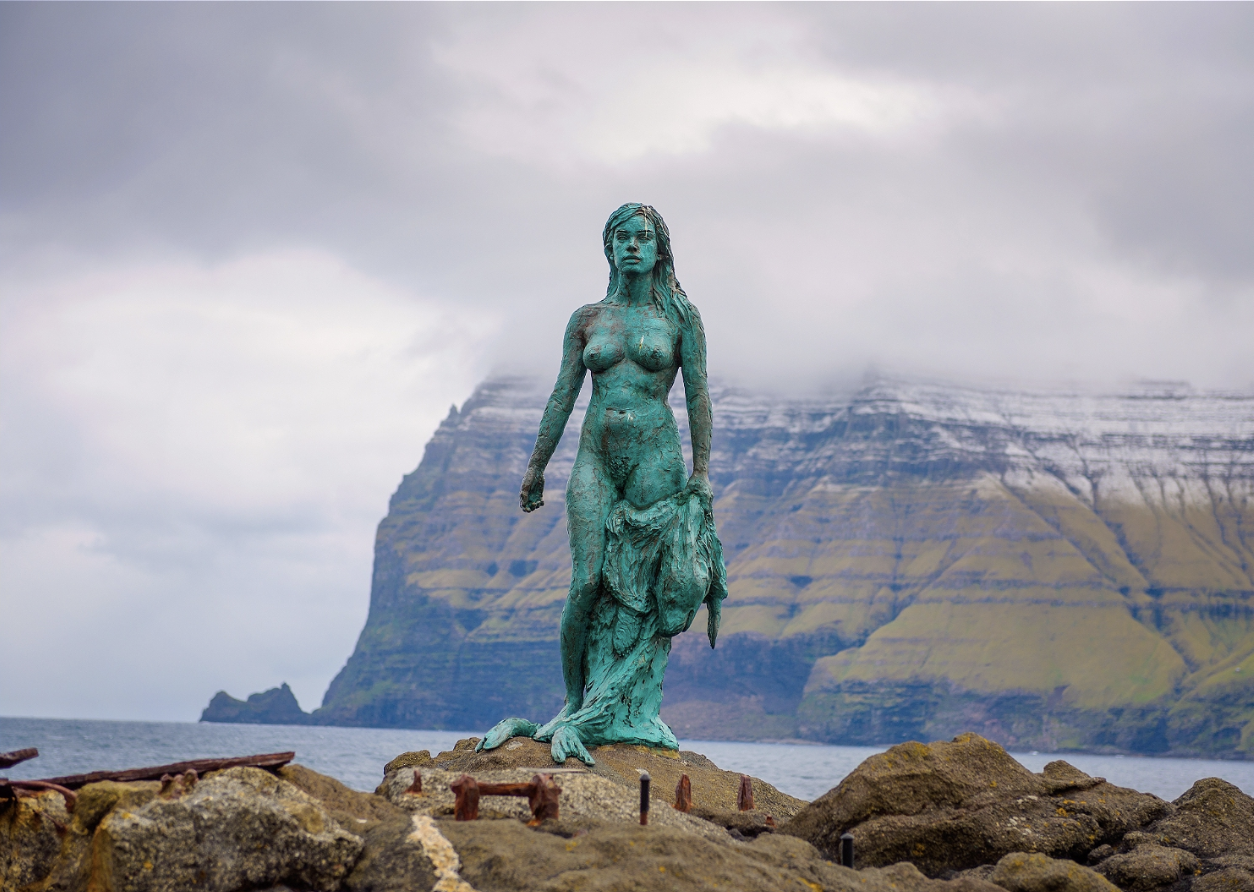
Written by Finn O’Branagáin and directed by Kurtis Laing, draws on Orkney mythology to tackle the heavy themes of domestic violence and coercive control. In folklore, selkies are creatures who live as seals in the sea, but shed their skins to live as humans on land.

Here, Rónnad (Celeste Cortez Davis) sheds her seal skin and finds herself stranded without it. She is “rescued” by Séan (Josh Hammond), who takes her into his home, clothes her, and vows to help her retrieve her skin. But the skin is gone, and its absence becomes the play’s central tension. Without it, Rónnad cannot return to the sea, leaving her bound to Séan and the relationship, no matter how suffocating it becomes.

What makes this production truly stand out is the movement direction by Josie Stanger-Jones that works seamlessly with the music, the sound designed by Matthew Forbes. Much of the relationship unfolds not through dialogue but through physicality: every breath, every hesitant touch, every lingering glance deepens the story. Dance and gesture become the vocabulary of the couple’s connection, mapping out shifts from desire to dependency, warmth to possession.

This low budget set is simplistic in nature, most of the action taking place in the living room built around just two couches. The simplicity throws the focus squarely on the actors, and the chemistry between Davis and Hammond is magnetic. Their connection is palpable, at times tender — intimate.

In the end, what lingers most about Selkie is its physicality. For a play about domestic violence, it finds imaginative ways to dramatise coercion and control. Yet at times it risks romanticising the relationship, softening the brutality of the subject. A more nuanced take could have pushed the work further.

Hell Is A Teenage Girl - She Threaded Dangerously: Old fitz

By Lola Kate Carlton

Old Fitz Unequivocally, beyond torture, death, or destruction, the most deplorable human experience has, and always will be female puberty. That god-awful period of thirteen to eighteen, where all of a sudden you’re at a very special age where you want things and have feelings that you’ve never felt before. And yet, it is not puberty itself that is the true evil of the Female Puberty ExperienceTM, it is the fact that we, as a culture, tend to throw our hands up to the sky and decide we don’t want to deal with it. In layman’s terms, we hate thinking about the fact that young girls get horny. Socially, we all expect it from young men. Teenage boy libido is built into our culture, into our media, into the way we interact with them on a day to day basis. However, in our refusal to think of our girls as anything else but little angels, we manufacture a blind spot for ourselves. Because we don’t give them an outlet for these new-found feelings, or even acknowledge they exist at all, they grasp behind our backs for what they can get, which tends to, ironically, put them in more danger than they would’ve been if we’d just let them explore in the first place. Truly, as Needy tells us in Jennifer’s Body, hell is a teenage girl.

Such is the thesis of She Threaded Dangerously at the Old Fitz theatre. A discomforting but culturally vital demand of us to acknowledge that if we don’t foster healthy desire, it will simply grow in other, more rotten places. Upon entering the theatre, the four young women, Mel (played by director Claudia Elbourne), Sophie (Larissa Turton), Luna (Karrine Kanaan) and Natalie (Alyssa Peters) are already sitting in the space. As we make our way to our seats, our presence immediately feels like an invasion. The Old Fitz’s tiny black box means that we almost have to step around them to make our way to where we need to go, and chips away at the standard separation between artist and audience. The stage is stripped back, three benches and a tree in the background, and relies on the narrative to do much of the imagining for it, although it successfully provided a backdrop for much of the piece. The four girls are dressed exactly the same, regulation uniforms that are both militarily sexless and eerily sexualised, as we see later in a skirt inspection scene and the only too familiar experience of the see-through white blouse. I was immediately drawn in by the performers. Even in the dark of the pre-show chaos, each character was decisively physically characterised, and in moments of reshuffling and adjustments, all the girls acknowledged the movement, checking in on one another. In this way, it felt less like a tableau and more like we were in a classroom with them, waiting for the bell to ring.

The piece began with an explosion of movement, which succeeded to create pacing and tension that carried throughout the rest of the piece. Although I must admit I am not personally a fan of the one-word-at-a-time storytelling that seems to be fairly popular in the independent theatre scene at the moment, it was an immediate focus point for the piece and created much of the early humour. Although, as I often find with this particular ensemble trope, when longer, fuller, more characterized lines are traded out for fast-paced rhythm, the slower scenes tend to suffer for it - and indeed, many of the earlier monologues struggled to find the settled emotional nuance needed for them to thrive. As the piece evolved, so did the performers, and slowing down provided all four enough time to comfortably settle into a much more naturalistic acting style. Perhaps the strongest example of this was Larissa Turton’s scenes with the adult cop she develops feelings for. Although perhaps slightly over-performing in their first scene, by her second one-on-one moment, she brimmed with the subtle anxieties and brash faux-overconfidence the character needed, and the two of them continued to impress for the remainder of the show. Karrine Kanaan was another substantial performer - and I was left wishing I had seen more of her throughout the piece. Kanaan provided a bullseye interpretation of the larger-than-life emotional experience of teenage-hood whilst never bleeding past the point of believability. Her monologue admitting that she had seen Sophie and the cop was delivered with beautiful light and shade. Alyssa Peters bloomed during the second half, really finding her stride in an incredibly touching moment between her and Kanaan where they express their most vulnerable anxieties about what’s happening around them. Claudia Elbourne, valiantly taking on the role late after the departure of Lilian Valverde, provides an energetic and watchable depiction of Mel - although lacks the vocal and emotional nuance of the actors around her, simply due to a lack of rehearsal time with the character. She did, however, provide an uncomfortably accurate representation of the too-overt clumsy sexuality of teenage girls. The men of the cast, although having significantly less on-stage time, certainly pulled their weight. Micheal Yore’s depiction of the new-age predator and the weaponisation of the teenage girl desire to feel special and interesting was truly bone-chilling, and Hamish Alexander and Leon Walsh provided strong emotional support to their scenes with the girls.

Past the performances, lighting designer Luna Ng and sound designer Alexander Lee-Rekers provided invaluable support to the climactic moments of the piece, keeping it on its feet and moving at all times. I was particularly drawn to Lee-Reker's use of a buzzing sound in the anxious moments of the play. Elbourne’s direction is incredibly clear stylistically and emotionally, bringing to it a cohesive flair often missing from young directors. The script drives at a fast pace, and although I understood why it thought it needed it, I was left wanting for a more thoughtful use of rhythm throughout the show. Much of the writing was slightly on-the-nose, which made the already difficult task of injecting nuance into the teenage experience even moreso. However, the insidious patriarchy that infests every character and the development of the stakes were done brilliantly. It also created an incredibly accurate portrayal of vengeful teenage cruelty and the manipulation tactics of their adult abusers. It, like the performers, seemed to begin to trust the audience more as the piece continued. I did wish for both Luna’s hinted queer identity and her viewing of Sophie and the cop’s relationship to be teased out further, but as the show continued 20 minutes past its advertised runtime, I understood why it wasn’t.

As a smash-cut of the dangers of the infantilization of teenage girls under patriarchy, She Threaded Dangerously shines, and leaves its audiences either reminiscing on their own pubescent experience, or for the men in the crowd, perhaps more willing to understand one they didn’t have. Its whipcords of tension and humour cross deliciously, and provide a strong thesis to its audience, one that they demand gets listened to. Led by strong performances and a cohesive style, it delivered a powerful emotional experience that will sit with me long after leaving the Old Fitz’s tiny theatre. Patriarchy is a clever animal, and it is up to us as the elders raised in it, to deny its continuation in the next generation, even if that means accepting the ick of teenage horniness.

Riverside Theatres: Trent Dalton’s Love Stories

By Elena Garcia Araujo

Should you watch Trent Dalton’s Love Stories? If you’re after a simple boy-meets-girl romance, this may not be for you. But if you want to see love redefined and your eyes opened to the many forms it can take, this play is well worth your time.

In 2021, Dalton spent two months sitting with his typewriter in Brisbane’s CBD, asking Australians from all walks of life one simple question: “Can you please tell me a love story?” The collection of intimate confessions became his book Love Stories. The stage adaptation, which made its debut at the Queensland Performing Arts Centre, has now arrived at Riverside Theatres Parramatta, adapted by Tim McGarry and directed by Sam Strong.

The play opens with narrator Jean Benoit, played by Rashidi Edward. He enters not from the stage but through the same door as the audience, beating a drum. This rhythmic entrance sets the pulse of the performance, as Benoit guides us through the unfolding stories alongside the typewriter that started it all. His presence is amplified on a large screen above the stage, creating an immediate sense of intimacy.

What makes this production truly distinctive is the use of close-ups projected onto that big screen. It is rare in theatre to be able to study an actor’s face at such proximity, to catch the flicker of a smile or the tremor of a lip. Those micro-expressions, normally reserved for film, become part of the live theatre experience, pulling the audience closer into the private world of each story. It gives the ensemble’s work an added layer of honesty and vulnerability that lingers well beyond the stage.

The staging is deliberately minimal. A sign reading “Sentimental writer collecting love stories” and a single typewriter draw the eye, while the screen at the back of the stage does much of the storytelling. It shifts from clouds to a starry night sky, echoing the characters’ journeys and underscoring the power of the words. Choreography by Nerida Matthaei adds another dimension, showing us the language of love in motion. At times bodies collide and intertwine in sweeping gestures that suggest passion and intimacy. At other moments, dancers peel away from one another, movements sharp and fractured, embodying separation, grief and the quiet ache of unrequited love. The physicality of these moments translates emotion into shape and space, giving the audience a visceral sense of the different textures of love.

At its heart, Love Stories reminds us that love is not one thing. It is parental devotion, the kind that says “we live to make our children happy.” It is the grief that holds on long after someone has gone. It is unrequited longing, love in sickness, messy love and enduring love. By the end of the play, we may find ourselves realising that soulmate love is not something we must keep searching for, but something already woven into our everyday lives.

The Art of Experimentation: Firehawk at Sydney Fringe

By Lola Kate Carlton

Sydney Fringe serves as one of the truest opportunities to fully immerse oneself into the experimentation aspect of the creative process. Creatives who want to build something sharp, raw, and never-before-seen will find a safe haven in this fast-paced festival. Out are the polished overdone works we’ve seen a hundred times, and in with the new, the fresh, the wonderfully innovative. Firehawk is right at home with Sydney Fringe in this regard, a bold and absurdist exploration of ideas done through a multi-genre, multi-media exploration of femininity and sisterhood through a 50 minute absurdist fairytale drama.

I stepped into Firehawk completely blind, knowing nothing of the thesis of the play or the world the performers were asking us to build and inhabit. In some regard, I feel now I did a disservice to the work by neglecting prior research into the questions the piece would then attempt to explore. Set in the cozy rooms of Erskineville Town Hall, the space is in some ways as bold and experimental as the work itself. Stripped back to necessary elements. Two boxes, two suitcases, a single basket of wood. As we settled in, a curling, eerie line of flute filled the space (played by Anna Rushmer), joined by a grounding piano score underneath it from Nathaniel Kong. The soundscape, paired with the flickering, fiery red of the lights, began to introduce us to the twisted fable we were soon to witness. The boundaries of the stage were created by us as the audience, seated in an L shape, which although often presents a blocking challenge for less experienced shows, was not a problem for this team. For an unconventional space and a tight budget, and without a dedicated set designer, the design of the space remains impressive in its decisive simplicity.

After thoroughly unnerving us through Firehawk’s composition, the piece began. In a gorgeous exploration of the unconscious dreaming of the play, Ella Roper took the stage in the leaps and bounds of reimagined ballet, immediately drawing us into the emotional world of the piece. In delicate white lace costuming, she resembled something just beyond the fingertip touch of reality. By the time Madison Chippendale peaked out from the curtain, we were transfixed by what the piece wanted us to feel, and so began the search for logic. Madison Chippendale is a strong performer- expressive eyes, complete and utter belief in her situation, a style just beyond naturalism but never painfully larger than life. This quality of performance never quivered, and in a piece this unusual, that must be credited. Indeed, all the performers were substantial in their own regards, strong representations of their form. Thus, my confusion throughout the piece cannot be credited at all to the performers themselves. The first speaking scene of the play defines the space we inhabit as a hotel in rural Australia, ravaged by consistent storms and the ever-present threat of the Firehawk, a destructive creature inspired heavily by the Brother’s Grimm Fitcher’s Bird. Instantly, the question in the room is “what is the Firehawk, and what does it mean for this piece?” My first guess - as scribbled down in my notebook - was “Climate ideas??” And yet, as the piece evolved, I understood my interpretation to be wrong, and yet was never truly given a ballpark of what was right, or perhaps, more importantly, what the creators of the piece were aiming for it to be. After researching the piece when I got home, the word “desire” crept out in the directorial vision. Thus, the “thirst” the Firehawk had created was of a more metaphorical sense and more literal sense than I’d understood it to be. In that regard, I wish I had been able to see the piece again with that framework of understanding, as I found the piece itself struggled to reveal that to me on its own.

The script, aside its flaws of clarity, did make up for it in beautifully evocative imagery. And indeed, the piece continued to be beautiful. Whipcrack moments of humour broke cleverly created moments of tension, and the relationships created on stage brimmed with clear trust and respect the performers had for one another. The composition work was incredibly strong, creating a story underneath the one on stage through motifs and bold dynamic work. Further, co-director Spark Sanders Robinson gleefully unveiled her expertise through the use of shadow puppetry in poignant moments of the show, never taking from the performers on stage. A particularly impressive example of such were the eyes of the hawk, and the flickering fire behind them. Ella Roper continued to impress with the delicate longing she created through her movement, and Madison Chippendale’s rising level of neuroticism kept the stakes high and her audience gripping their seats. Madison successfully played multiple characters and re-enacted full conversations, and Rushmer was a strong critical voice of realism throughout the play. Admittedly, when on stage together, a vocal strength disparity did emerge between the three women, and I found at points both Roper and Rushmer were struggling to keep up to the dynamics Chippendale was setting. Furthermore, both were slightly greener actors, and at times lacked the emotional nuance needed in specific moments. However, in a multi-media setting such as the one Firehawk was presenting, these discrepancies are easily forgiven through the showcasing of each performer’s primary medium. The story’s ever-evolving twists and turns consistently engaged the audience, and I was deeply intrigued by the idea of being forgotten that the story began to create through the back half - although somewhat ironically, seemed to also somewhat forget. In its final moments, the brutality of the play built to an explosive finish as Chippendale’s character is revealed to have been behind the mythical killings of the Firehawk, its imagery reminiscent of Lady Macbeth as she scrubs at her spots. The sisters, now reunited as a complete front, are prepared to tackle the storms of the future, and finally satiate their “thirst”, delivering a dark, grinning look to the audience as if tempting us to join them. This metaphor, although evident upon my later research, required a stronger foundation throughout the piece to be fully actualized for the audience in the room - especially when surrounded by other images that sway the connotations of the idea.

Upon reflection in the foyer, I was left with two final thoughts, firstly, that the play had succeeded in making me feel something, and second, that whatever it was trying to tackle, I hadn’t quite wrapped my head around whilst in the room with it. Many younger works often struggle with this issue, a desire to tackle a multitude of ideas vaguely rather than zeroing down into a crystal clear singular thesis. However, I will never be caught saying that this is some sort of cardinal sin in the act of theatrical creation. Sydney Fringe Festival is built for experimental works of theatre like Firehawk, and the piece was deeply enjoyable as the active work of creation that it was. As a self-devised work, Firehawk is an innovative and confident example of the opportunities of multimedia and absurdism in theatre, and is a deeply soothing example of the future of Sydney theatre at large.

ENSEMBLE Theatre: How to Plot a Hit in Two Days

By Elena Garcia Araujo

How to Plot a Hit in Two Days is a new Australian play by Melanie Tait that transports its audience back to a golden era of television, when free to air was the only option. The play is set in 1985, at the height of A Country Practice, one of Australia’s most loved dramas.

Set in the fictional rural town of Wandin Valley, A Country Practice brought stories of family, community, and rural medicine into living rooms across the nation. At the heart of Tait’s play is one of its most unforgettable storylines: the death of Molly, a character whose warmth and humour made her a household favourite. We are taken into the writers’ room, where the creative team grapple with how to script her final moments. The premise is both funny and deeply poignant, as the decision to kill off such a beloved character weighed heavily not only on the writers but also on the millions of viewers who had welcomed her into their homes.

That cultural impact was palpable on the Friday night I attended. During the post-show Q&A, one woman, teary eyed, shared that she had first watched A Country Practice with her late mother. For her, the play was more than entertainment; it was a reminder of family, community, and the shared ritual of watching television together. That moment captured the spirit of the evening: this was more than a play, it was a collective return to the good old days. Belly laughs rang throughout the theatre, sparked by inside jokes and memories that only those who lived through the 1980s could fully appreciate.

The ensemble cast capture the energy of a writers’ room with sharp timing and playful chemistry, balancing the lightness of comedy with the emotional weight of the task before them. The play moves with a brisk rhythm, keeping the laughs flowing without losing sight of the deeper cultural resonance beneath the humour.

The set design completes the immersion. Mustard yellow and sage green walls instantly evoke the era’s suburban interiors, while a plaid couch with heavy armrests anchors the stage in late seventies and early eighties style. At the centre is a large corkboard, where the writers pin major plot points. More than a prop, it becomes a visual anchor, reminding us that what once sat on such a board could ripple across an entire nation.

This production highlights the strength of Australian theatre, with its ability to tell our own stories with humour, warmth and honesty. Tait shows that revisiting and celebrating our cultural history can be just as powerful as staging international works. It is a timely reminder of how important it is to see more Australian stories brought to the stage.

Old Fitz: Chekov’s Cream Pie: The Balloon Dog Bites

By Lola Kate Carlton

The nature of the artistic experience is almost always a humiliating one. As artists, we face more than anyone else the badgering questions of friends, of relatives, of lovers, of total and complete strangers. “What are you still doing in that job?” “When are you going to grow up and pick something different?” “Why can’t you let this go?” No matter the love we feel for our craft, creative expression and public shaming seem to forever exist hands entwined, only more true when combined with the queer experience. Thus, we are faced with the question we must all ask ourselves if we plan to take art seriously: What do I care about more? Being a good, well rounded grown up person with a real job, grounded relationships, and a steady future- or this?

It’s this question that The Balloon Dog Bites tackles in its fifty minute interrogation into the humiliation ritual of artistry. As a one man show, we are invited into the intimate and vulnerable crevices of Paulie Accio’s mind (Micheal Louis Kennedy), and lead through his no-good-very-bad day as a practising clown at an Eastern Suburb brat child’s birthday party. Upon entering the space, the aesthetics of the show immediately jump out at you. Blues and whites invoke both a children’s birthday party in all of its cruel innocence, and simultaneously, the feeling of a long-standing depressive episode. Immediately, classic conventions of theatre are broken as Kennedy wanders through the audience, handing out scripts, birthday party hats and instructions for heckling. Immediately, I was impressed by the costuming. An aesthetic combination of Paris’s Pierrot and Comedia del Arte’s Harlequino, big fluffy gently sparkling patches of baby blue and creamy white seamlessly meld Kennedy into the aesthetics of the piece, harken back to clowning’s history whilst also being ever so slightly uncomfortable to look at.

The play starts with a jump of classical music, and a single spot on Kennedy as he somberly applies makeup, wasting no time to introduce us to the comedy of the piece as he cuts face powder into a line with a credit card, then artfully presses to his nose and cheeks. Credit here must go to Oliver John Cameron’s brilliant sound design. Although Kennedy’s voice largely suited the script’s grinning pessimism, I was left wanting in a few key moments for more vocal strength and inflections through his performance - each emotional moment incredibly valuable in a piece this dry. As he jumped between characters, first, the tyrannical French clown teacher, then the buttoned up Eastern Suburbs mother, the genius of the script-writing was exposed. Each character, including Paulie himself, could’ve benefited from slightly more physical and vocal commitment, but with each razor-sharp quip of the writing, constantly moving so fast you had to pay attention or be left behind, any complaint is quickly forgotten. Much of Kennedy’s performance was beautiful in its subtlety, each turn, step and facial expression delightfully deliberate. This continued into the clowning work done throughout the piece. Although two out of the three “sets” acted more as a satire of their original form, the first set, a mime act, was a stunning example of the form. Kennedy zeroed in to a crystal clear objective, and each movement brought the joke forward in a way that dripped with expertise. It was at this moment that I became utterly convinced of the character’s love for clowning, which was a necessary cornerstone to the larger thesis of the piece.

The emotion of the piece comes out through Accio’s cigarette breaks (a brilliant use of prop comedy as he pulls a lit cigarette out of his clown costume) and the conversations he has with one of the neighbors, John, and his senile dog Daisy as he recovers from his sets. Here, Accio admits to us the mourning of past lovers, the discomfort of committing to art as he gets older, and how his will to continue is tested. In easily the most beautiful moment of the show, Kennedy describes a friend from clowning school who’d just lost their father, who delivers a joke about it so well crafted and well timed, Accio began to cry. The older man, in turn, represents the average Australian response to the committed artist, in both his lack of understanding and tentative support. These moments of vulnerability and comfort drive our sympathy for Paulie, and allow us to connect to him properly and feel both his anxiety and wrath when faced with the abuse at the party. The children at the party, played by us in the audience, take turns poking at Accio’s insecurities and asking the questions every artist has heard a hundred times (clearly, as Kennedy mouths along to the script on stage). Kennedy feels this humiliation, then the subsequent exhaustion completely in his body, and we watch the costume literally disintegrate as his will to continue does. It is here that Chekov’s cream pie is first brought up, serving as a brilliant metaphor for society’s willingness to abuse art for entertainment without regard for the artist themselves.

The stakes continue to build as the abuse from the party-goers worsens, the demands for Accio’s degradation increases and the heckling from the audience becomes targeted and more specific. Suddenly, in a flashing red and white, the children begin to attack him and he is forced to retaliate by flinging one of them over the fence into the neighbour’s garden, straight into Daisy’s jaws. In perhaps the only heroic moment of Accio’s life, he leaps after the child, and is in turn bitten. Time stops, a spot from above opens bright, white heavenly light onto Accio’s panting face. He begins to break down from the pain, and through this breakdown has a moment of true self-actualization, delivering a profound message on the nature of accepting shame for the purposes of artistic expression. His costume is in tatters by this point, and the violence has built to where it almost isn’t quite funny, and yet, as he stands there, leg covered in blood, he is grounded for perhaps the first time. The play ends with the world’s final attempt to degrade him, a cleverly disguised AIDs comment from Christina’s father - “you didn’t get any of that clown’s blood on you, did you honey?” - and yet, instead of being forced into the acceptance of this humiliation, he is finally driven into a moment of power and vengeance. The clown hat comes off, revealing a second, smaller clown hat, and Chekov’s cream pie is realized through the hurtling of a creme brulee at his attackers as he sprints off stage.

The Balloon Dog Bites presents a sharp, funny reality check for the artists of the world, reminding us that we cannot escape the humiliation society will shove our noses into. Our only power then, is through radical self-acceptance and reminding ourselves that we have chosen this needlessly difficult path because we love it. Although the piece could’ve benefited from slightly more energy, on a holistic level, it thrives as a cynical dissection of the creative experience, and the fact that though we may create hungry, though we may create in pain, or sick, or bored, or heartbroken, we cannot stop ourselves from continuing the act of creation.

New theatre: The Frogs: In Hell They Sing Show Tunes

By Liron Peer

Camp, comedic and apocalyptic with a stirring modern touch. Alex Bendall Robson delivers on his world premiere of ‘The Frogs: In Hell They Sing Showtunes’, now showing at the New Theatre.

Right off the bat, you know you are in for a form-bending treat, as Dionysus (Pat Mandziy), the god of theatre and wine and his vexed sidekick Xanthias (Eddy O’Leary), begin the play trying to think of jokes to tell the audience/Heracles and land on knock knock. This dynamic duo have a great commitment to character, and their portrayals juxtapose brilliantly together.

The play follows Dionysus and Xanthias on their journey to the underworld. ‘The world is on fire, people are dying. There’s war and plague and cuts to arts funding. It’ll take a bloody miracle to save humanity.’ In this apocalyptic world, Dionysus gets the idea to resurrect a dead playwright who will save humanity. What ensues is an entertaining and bleak journey, including an off-Broadway serenade by an ensemble of frogs. It was nice to see the cast work so effortlessly together and their commitment to ‘the bit’. Expect some lovely singing, the flute and lots of charisma. Pat Mandziy delivers a hilariously privileged and lascivious Dionysus that balances out well with the rest of the mixed bag of characters. Including: Axel Berecy’s dim-witted and obnoxious Heracles, James Robins' stark and captivating performance as the Porter, and Nicholas Starte’s sardonic Hades. Holly Nesbitt's lighting design helps create the differing atmospheric modes throughout the piece, as well as sound design by David Wilson that builds dramatic effect, allowing the moments of silence to pay off.

This play will sweep you up in its fabulously curated comedy that oddly uplifts the dire truths of modern society.

Sydney Theatre Company: The Talented Mr. Ripley

By Aidan Hale

It’s always a challenge producing theatre of a work known mostly for its representation in other mediums. On top of actually putting on a production (which in of itself is a hard thing to do), questions about adaptation are always floated. How much do we take from this other rendition of the story? How different should we be from the source material? There’s a delicate balance between too much and too little deviation that all good adaptations must aim for, or otherwise drown in one end of the scale.

I’m pleased to report that what surfaced from Sydney Theatre Company’s ‘The Talented Mr. Ripley’, for the most part, hits the good balance of an adaptation. Directed by Sarah Goodes and adapted by Joanna Murray-Smith, ‘The Talented Mr. Ripley’ follows an abridged and slightly altered version of Patricia Highsmith’s novel.

Tom Ripley (Will McDonald), the titular talent himself, is a young grifter looking to escape his mediocre life in New York City. When Ripley has a chance encounter with the prestigious Greenleaf family, he is sent to Italy on a mission to convince their charismatic heir, Dickie

Greenleaf (Raj Labade), to return home. However, upon arrival, Ripley is swept into Dickie and his girlfriend Marge Sherwood’s (Claude Scott-Mitchell) glamourous lives and begins obsessing over Dickie.

McDonald is an undeniable powerhouse as Ripley. Masterfully blending and blurring the character’s motivations into an intriguing biography of an undesired man. Invisible but charming; calculating and reckless; envious or possessive. McDonald inhabits each contradicting facet of Ripley in a standout, flexible performance. His dynamic with Labade is of specific note: the innocence and playfulness between Ripley and Dickie turned to disgust and animosity was as fun as it then became heartbreaking.

Director Goodes does a lot to bring these dynamics and performances to life visually. Ripley and Dickie’s dance under glittering tassels, a choreographed swing of umbrellas as Mongibello’s beaches are formed, Dickie’s train compartment pulled slowly away from a panicked Ripley. Goodes, and Set Designer Elizabeth Gadsby, draw on Brecht’s minimalistic, yet elegant approach to theatre for a direction that is nothing short of cheeky and colourful. At one point in the play, the walls literally close in on Ripley. Maybe Goodes is a little too cheeky and simple at times, but I definitely found it charming. Although the more filmic decisions, like the trope of Americans spicing their language up with some Italian, felt more out-of-place than it did charming.

That said, props for the colourful moments must also be given to the fantastic ensemble work and sound design. Movement Director Charmene Yap makes the ensemble feel like a part of the world themselves. They’re always on the fringes of Ripley’s story, imbuing the places we go to with so much more life. Assisting this are the jazzy sounds composed by Steve Francis and Madeleine Picard. It makes the world of Ripley feel busy and lively, but the shady undertone accompanying reminds us that something isn’t quite right: that Ripley’s story is fraudulent.

Truthfully, my hesitance with this production unfortunately comes from Murray-Smith’s script. While I appreciate how good a job she does in condensing 252 pages into a 2-hour performance, the result is that the script lacks a bit of punch. The first half is paced a bit too

fast and the second paced too slow. Though we get some great moments to breathe in the middle, the play doesn’t always strike the right impact.

Regardless of my reservations, I think ‘The Talented Mr. Ripley’ finds the middle ground it needs to be a good adaptation and good theatre. It’s not always a killer, but it is a fun time.

‘The Talented Mr. Ripley’ is playing at the Roslyn Packer Theatre until September 28th.

Griffin Theatre Company: Birdsong of tomorrow

By Benjamin Tigre La

On entering the Old Fitzroy hotel, a warmth permeates from the small fireplace, it hits me. There is a comforting kind of chaos. The sound of intermingling, glasses clashing, metal utensils scraping against plates. It is loud and busy and everything an Australian pub should be. In the corner, people crowd around a band playing jazz. The jazz lingers so I linger. I head downstairs into the theatre. The Old Fitz is not a big theatre. With a capacity of 55 seats, it begs for intimacy. The theatre fills up slowly, the chaos of the outside reduces to distant murmurs, and the show begins. 

Birdsong of Tomorrow is not just a theatre show. It feels communal, like sitting in your friend's parent’s office after school, listening to them talk about their special interests. The core of this work is, like the name suggests, about birds, and, if I only learnt one thing from this show, writer-performer Nathan Harrison loves birds. It is a crash course on all his favourite birds; the buff-breasted paradise kingfisher, the superb fairy wren, the wandering albatross. Alongside these are observations of the world, the passing of time, the anxieties around change and yet also the anxieties around everything staying the same. Harrison bares his heart in his work, not just his love for birds but also his deep sense of grief that he hasn’t fully reconciled with yet. So perhaps crash course was the wrong term to use, it felt more like a long rant, equal part fact, equal part poetry. One line stuck to me early in the show, that I had to scribble down, “Nothing sang before the birds.”

Like all conversations, sometimes I felt that there were lulls, points where I felt my energy drop and perhaps my attention faltered for a second. It could very well be my fault. I realise I didn’t have as strong opinions on birds as I originally thought. Maybe I should have stronger opinions on birds. Nevertheless, Harrison’s passion and joy was so infectious. Even in these lulls, he was quick and witty, creating great comedic moments. His description of the migratory journey of certain birds or the wingspan of others commanded the space, moving the theatre with him. He performs with the confidence only granted to someone with complete faith in his writing, he is funny, honest, and deeply likeable. 

The stage is littered in nostalgia, an old school projector, a tape recorder, a record player. They do not simply serve as props, but are utilized masterfully throughout the production. Artworks of birds are projected onto screens, recording spin playing bird sounds. The soft hum of analogue machinery underscores the entire performance. They hum with history, forcing us to look back not just at the histories of the show but our own histories. The addition of a live musician Tom Hogan, creating a soundscape for the work was an amazing touch. He was very evidently not just a musician but also a friend of Harrison’s which created a deeper sense of intimacy within the work. 

In the end, Birdsong of Tomorrow, is a reminder to pause, to notice. It calls for us to slow down amongst the chaos of life and delight in the world that we live in, to look at the birds. Nathan Harrison’s passion, humor and honesty bleeds into the audience. He asks nothing of us (except to make the occasional bird sound), except to glimpse into his world and listen.

The Face of Jizo: Memory, Translation, and the Ghosts of Hiroshima

By Katie Ord

How do you translate grief? How do you relive memories? Most importantly, can you? The Face of Jizo, currently showing at the Seymour Centre after a season at the Old Fitz, asks us to reckon with Hiroshima’s aftermath through the intimacy of a two-hander. Written by Hisashi Inoue in 1994 and translated by Sydney local Roger Pulvers, this production is guided by directors Shingo Usami and David Lynch, and produced by Omusubi Productions with co-producer Jade Fuda.

Translation as Cultural Nostalgia

Translation is always a negotiation. While Pulvers’ version occasionally pares down the lyricism of Inoue’s original text, losing some of the symbolic connotations of Japanese dialogue, it makes the story accessible to Australian audiences in a direct, clear and relatable way. What lingers is the universality of trauma and resilience, even if some of the original poetic nuance is softened and replaced by cultural inferences that feel tailored to an Australian audience than a Japanese one.

Direction and Staging

Flashbacks are notoriously difficult to stage, yet Usami and Lynch make bold, simple choices. Instead of heavy reliance on lighting tricks or sound effects, the past is evoked through gestures and memory fragments: cleaning, wringing, miming small household rituals. It’s restrained but effective, letting the performers’ bodies carry the weight of time.

The stage picture, though often concentrated on stage right, is anchored by Tobhiyah Stone Feller’s set design, a space defined by tatami mats, a sliding wardrobe reveal, and the warm glow of a Japanese lampshade. It feels authentic, lived-in, and delicately composed. Matt Cox’s lighting design and Zachary Saric’s sound are subtle yet well-judged, never overwhelming the performers, while Me-Lee Hay’s composition lends a soft emotional undercurrent to the production.

Performances

The heart of this production lies in its performers.

Mayu Iwasaki (Mitsue) delivers a tour de force. Her performance is layered with guilt, grief, and resilience, and her monologues are genuinely heart-rending. The constant wringing of a cloth in her hand recalls Lady Macbeth, but here it becomes a symbol of unbearable memory. By the end, her tears drew my own. Shingo Usami (Inoue), doubling as co-director and actor, offers a playful, humorous counterbalance as the father’s ghost. While some of the more serious scenes lean into bluntness, his warmth and comic timing keep the piece buoyant. Together, the duo create a dynamic of daughter and father that oscillates between tenderness and tension, reminding us that memory itself is never linear, it slips between humour and horror, levity and loss.

Design as Atmosphere

The creative team succeeds in weaving an atmosphere that feels both authentic and theatrical. Costumes are neat and symbolic, the props functional if at times impressionistic. The cutting of vegetables may not always signify a clear meal, but it does root the characters in a sense of ordinary domesticity, a reminder of what was shattered by war. The tatami mats, meanwhile, provide a grounding world for the actors, with humour threaded in through simple staging choices.

A Necessary Witness

What emerges from this production is less a literal retelling and more a meditation: how do we carry the unbearable into the present? The Face of Jizo doesn’t aim for spectacle, but instead for intimacy, an honesty that invites us to witness grief without embellishment.

Independent theatre is often where the most daring conversations take place, and this production proves it. With Omusubi Productions steering and a deeply thoughtful creative team, this staging brings Hiroshima’s ghosts into our present with grace, humour, and devastating clarity.

Go for Iwasaki’s extraordinary performance, stay for the quiet power of the staging, and leave reminded that memory itself is theatre: fragmented, fragile, and achingly human.

Riverside theatres: Trophy boys

After a sold-out season in New York, the Trophy Boys returned home to tour in Australia, arriving at Riverside theatre on August 6th to a tame opening night. 

The set up was exciting and promising. A cast of female and non-binary actors expertly portray a private boys debating team, trapped in a room with the looming assignment “feminism has failed women: affirmative”. 

What follows is exactly what you would expect. About 40 minutes of the four boys desperately trying to find a winning argument that doesn’t cost them being labelled misogynistic pratts and all the while revealing, in not so subtle outbursts, the hypocrisy of their supposed feminist stances. 

This leads to the twist half-way through where (spoiler alert), they find out a news article has been released accusing a member of their debating team of sexual assault. From here, the play adopts a much darker tone as the audience is privy to the sinister truths that hide beneath their normalized behaviours and attitudes. These revelations allow for some of the strongest and most captivating performances throughout the show, particularly when Owen, the most convincing feminist on the team, is accused by the other boys as being the assaulter. As the boys are forced to confront the potential consequences of their own actions, the hierarchy and dynamics of the group pull and shift as they each desperately cling to solutions.  

However, ultimately I struggled  to feel any degree of true shock or betrayal at these revelations given that their characterisation in the first act was so satirised that it was difficult to connect with any of the boys as fully fledged characters. It could be argued that this was exactly the point, that the comedy demonstrates just how easily we accept and infantilise the misogynistic behaviour of young boys as just ‘boys will be boys’. Yet at points it felt that the story ceded to cheap laughs over building characters that we can emotionally invest in (ridiculous and immature as they may be). Whilst hilarious at first, eventually the satire began to feel repetitive, superficial and ultimately unsatisfying.

Once On This Island at Hayes Theatre Co – Reimagined Through the Lens of Indigenous Dreaming.

By Elena Garcia Araujo

If you’re after something warm, rhythmic, and full of soul, Once On This Island is your next must-see. This feel-good, heart-holding musical wraps you in colour, community, and connection, all while asking one of life’s biggest questions: what wins, love or death?

With Moana-like magic, this Australian adaptation bursts with life. The choreography is bubbly and impeccably timed, joyous, passionate, and full of heart. There’s a deep sense of soul in every movement, made even more powerful by the show’s cultural richness. Set against a backdrop of minimal staging, the performers use every inch of space creatively, inviting the audience into the world of Ti Moune, a dreamer with childlike wonder and fierce hope.

At its core, Once On This Island is a coming-of-age story about sacrifice, betrayal, and the deep spiritual journey of a girl who dares to want more. Ti Moune isn’t just waiting for love, she’s waiting for life to begin. Guided by the gods of her island, she steps into a destiny that transcends romance.

Director, Brittanie Shipway, a proud Gumbaynggirr woman, brings something truly special to this Australian staging:

“As a Gumbaynggirr woman with Aboriginal roots, I really wanted Ti Moune’s story to feel like a dreaming story,” Shipway shared. “In bringing Once On This Island to Australia, I didn’t want to copy the American version, I wanted to honour the many cultures that make up this country. Some of the cultures reflected in this production include Tongan, Samoan, Māori, Brazilian, Salvadoran, Filipino, and of course First Nations. I wanted the cast to represent who they are authentically, to bring their own languages, cultural dances, and costumes into the show, rather than pretending to be from the Caribbean.”

That commitment shines. There are beautiful hints of Indigenous dreaming, natural connection, and ancestral rhythm. The show becomes not just a story from one place, but a celebration of many cultures meeting beautifully in cultural harmony, a rare and powerful thing on Australian stages.

And at the centre of it all is Ti Moune. Actor Thalia Osegueda Santos, who plays her, reflected:

“Getting to know Ti Moune has been a real journey. For a long time, I was trying to figure out who she was, and then it finally clicked. We’re so alike. We’re both naturally curious, and we share a deep love for healing, family, and culture.”

That love radiates. You feel it in the songs, in the sway of the dancers, in the stillness of the moments between joy and heartbreak. This isn’t just a boy-meets-girl story. It’s a god-guided journey through the thickets of destiny, class, culture, and spirit. And maybe—just maybe—it asks us to redefine love itself.

Once On This Island is full of rhythm, full of culture, and full of heart. And while romance drives the story, by the end, you may find the most powerful kind of love isn’t romantic at all.

Once on this Island is playing at Hayes Theatre Co. until the 31st of August 2025

Sydney Theatre Company: Circle Mirror Transformation

By Faye Tang

For its almost absurdly minimalist name and premise (four strangers participate in an amateur acting class; drama ensues), Circle Mirror Transformation tunes into a wonderful polyphony of emotional experience. 

This charming ensemble piece is built almost purely on characterisation, like a 19th-century realist experiment. Marty (Rebecca Gibney), the acting instructor, is classically bohemian, from her sweet husky voice to her myriad shawls. Her husband, James (Cameron Daddo), is a little harder to decipher, a renegade older man who used to be a revolutionary. Theresa (Jessie Lawrence) and Schultz (Nicholas Brown) are at once recognisable as millennial spoofs, the former touting perma-pilates garb, the latter a klutzy carpenter played with impressive slapstick physicality. And my favourite, Lauren (Ahunim Abebe)—the most naturalistically written and embodied, a close-to-heart high schooler, shy and ironic but later wonderfully witty, who harbours dreams of being an actor.

Though most of the play was anchored in a gentle naturalism, the third act ushered in an uneasy feeling that the delightfully character-driven story was lurching into conflict with a superimposed plot. In the final climax, the ensemble sits in a circle and writes a “secret they’ve never told anyone else” on slips of paper. These—in a frustratingly predictable way—turn out to be sensational, relationship-breaking ‘secrets’, which the audience has been clued into throughout the play. Marty reveals a horrific childhood trauma that’s played for shock and left unexplored; James lets loose his adulterous love for Theresa in a singularly bombast and unrealistic moment; Schultz is again mined for comic relief, misspelling his secret and confessing his addiction to internet pornography, the cherry on top of a Frankensteinian hodgepodge of millennial stereotypes. Chekhov’s gun goes off and off and off, long after any meaningful target has dropped well and dead.

The play travels along the trajectory of Plath’s fig tree: a bright young thing, seductive in its easy subtlety, but curdles as it grows, sucked into the formal constraints that hang heavy over it like April fog. Schultz is straitjacketed into a sitcom ass, as if true bohemians died with the aging of Gen X; short-story sensationalism overwhelms the denouement, bringing an otherwise subtle, gently explorative play to an unreasonably histrionic end.

Despite the ending, Circle Mirror Transformation is a riveting and capacious experience. Its strengths lie in its self-reflexivity, in the delightful inception of actors pretending to be actors. Particularly striking are scenes of layered pretense, as when James (pretending to be Theresa’s ex) fulfills the part of an emotionally abusive partner to Lauren (embodying Theresa), who tries to refute his manipulative tactics in a manner too healthy and detached for Theresa who, enraptured by James’ theatrical reenactment, is pulled earnestly and stridently into the argument, so thick with emotion it’s almost tangible.

The web of metatheatricality is weaved so effortlessly by the actors, easing the audience from one melodrama to another, all the while deepening our relations with each character. It’s a clever ensemble piece, at its best when slow, subtle, and meandering.

Love in a Thoughtless World: 1984 at Riverside

By Elena Garcia Araujo

If you've ever felt policed for thinking differently, for dreaming too boldly, loving too freely, or questioning too loudly, 1984 at Riverside Theatres is your mirror, your warning, and your wound. 

From the moment a spotlight scans the audience, we are no longer just watching. We are being watched. Bomb sounds erupt in sync with flashes of light. The world of 1984 is cold, grey, and stripped of comfort — and the stage reflects that perfectly. Stark lighting evokes confinement. A looming screen tracks Winston’s every move and thought, flickering with self-taped confessions that blur the line between memory and surveillance. 

Winston’s connection with Julia is subtle, flickering, forbidden. In their rare moments of intimacy, the lighting shifts. Warm tones enter briefly, offering colour in a world drained of it. In a thoughtless world, even the act of thinking becomes dangerous. 

They are star-crossed not by feuding families, but by a system that punishes feeling. Like Romeo and Juliet, they hide their love in secret places. But unlike Shakespeare’s lovers, they don’t die together in defiance. They survive each other. They are broken apart, psychologically destroyed, then turned against one another. Betrayal replaces tragedy. Silence replaces sacrifice. This is Romeo and Juliet rewritten by a fascist state. 

If you've ever longed for a version of Romeo and Juliet where love is punished not with death but with slow erasure — where passion survives only to be undone — then watch this play. It won’t offer comfort. But it will offer truth.