
By Elena Garcia Araujo
Should you watch Trent Dalton’s Love Stories? If you’re after a simple boy-meets-girl romance, this may not be for you. But if you want to see love redefined and your eyes opened to the many forms it can take, this play is well worth your time.
In 2021, Dalton spent two months sitting with his typewriter in Brisbane’s CBD, asking Australians from all walks of life one simple question: “Can you please tell me a love story?” The collection of intimate confessions became his book Love Stories. The stage adaptation, which made its debut at the Queensland Performing Arts Centre, has now arrived at Riverside Theatres Parramatta, adapted by Tim McGarry and directed by Sam Strong.
The play opens with narrator Jean Benoit, played by Rashidi Edward. He enters not from the stage but through the same door as the audience, beating a drum. This rhythmic entrance sets the pulse of the performance, as Benoit guides us through the unfolding stories alongside the typewriter that started it all. His presence is amplified on a large screen above the stage, creating an immediate sense of intimacy.
What makes this production truly distinctive is the use of close-ups projected onto that big screen. It is rare in theatre to be able to study an actor’s face at such proximity, to catch the flicker of a smile or the tremor of a lip. Those micro-expressions, normally reserved for film, become part of the live theatre experience, pulling the audience closer into the private world of each story. It gives the ensemble’s work an added layer of honesty and vulnerability that lingers well beyond the stage.
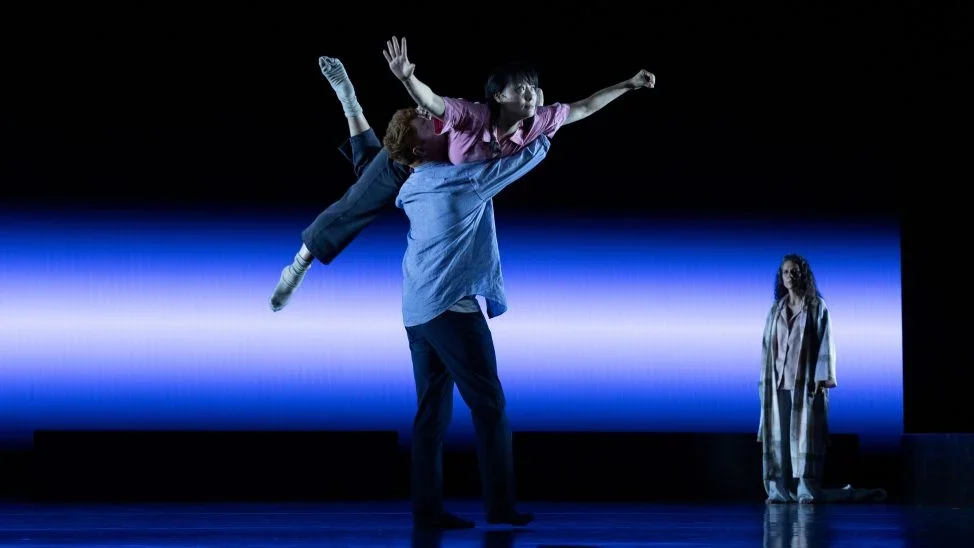
The staging is deliberately minimal. A sign reading “Sentimental writer collecting love stories” and a single typewriter draw the eye, while the screen at the back of the stage does much of the storytelling. It shifts from clouds to a starry night sky, echoing the characters’ journeys and underscoring the power of the words. Choreography by Nerida Matthaei adds another dimension, showing us the language of love in motion. At times bodies collide and intertwine in sweeping gestures that suggest passion and intimacy. At other moments, dancers peel away from one another, movements sharp and fractured, embodying separation, grief and the quiet ache of unrequited love. The physicality of these moments translates emotion into shape and space, giving the audience a visceral sense of the different textures of love.
At its heart, Love Stories reminds us that love is not one thing. It is parental devotion, the kind that says “we live to make our children happy.” It is the grief that holds on long after someone has gone. It is unrequited longing, love in sickness, messy love and enduring love. By the end of the play, we may find ourselves realising that soulmate love is not something we must keep searching for, but something already woven into our everyday lives.