
By Olivia Zaia
With Sydney plummeting to its lowest owner-occupier rate since the 1950s, real estate might just be the least attractive topic for a night of entertainment out there. But topicality need not be the death of quality drama.
At Woolloomooloo’s historic Old Fitz Theatre, Irregular Programming’s Dealing With Clair is stunning its audiences with all the humour and horror of selling houses in 1980s London. Under the satirical precision of director Harry Reid, Martin Crimp’s 1988 play is as lively and pertinent as ever, animated by performances that are near impossible to fault.
Coming full-circle, Crimp’s plays were first performed above a pub. Now, they’ve made their way to the Old Fitz basement: vibey, intimate and enveloping. Just as long as you’re not claustrophobic. Or adverse to rather upright bench seating. Or scared of ghosts from 1860. But hey, it’s not often you can go from a pint and pub feed to a show in about ten steps.
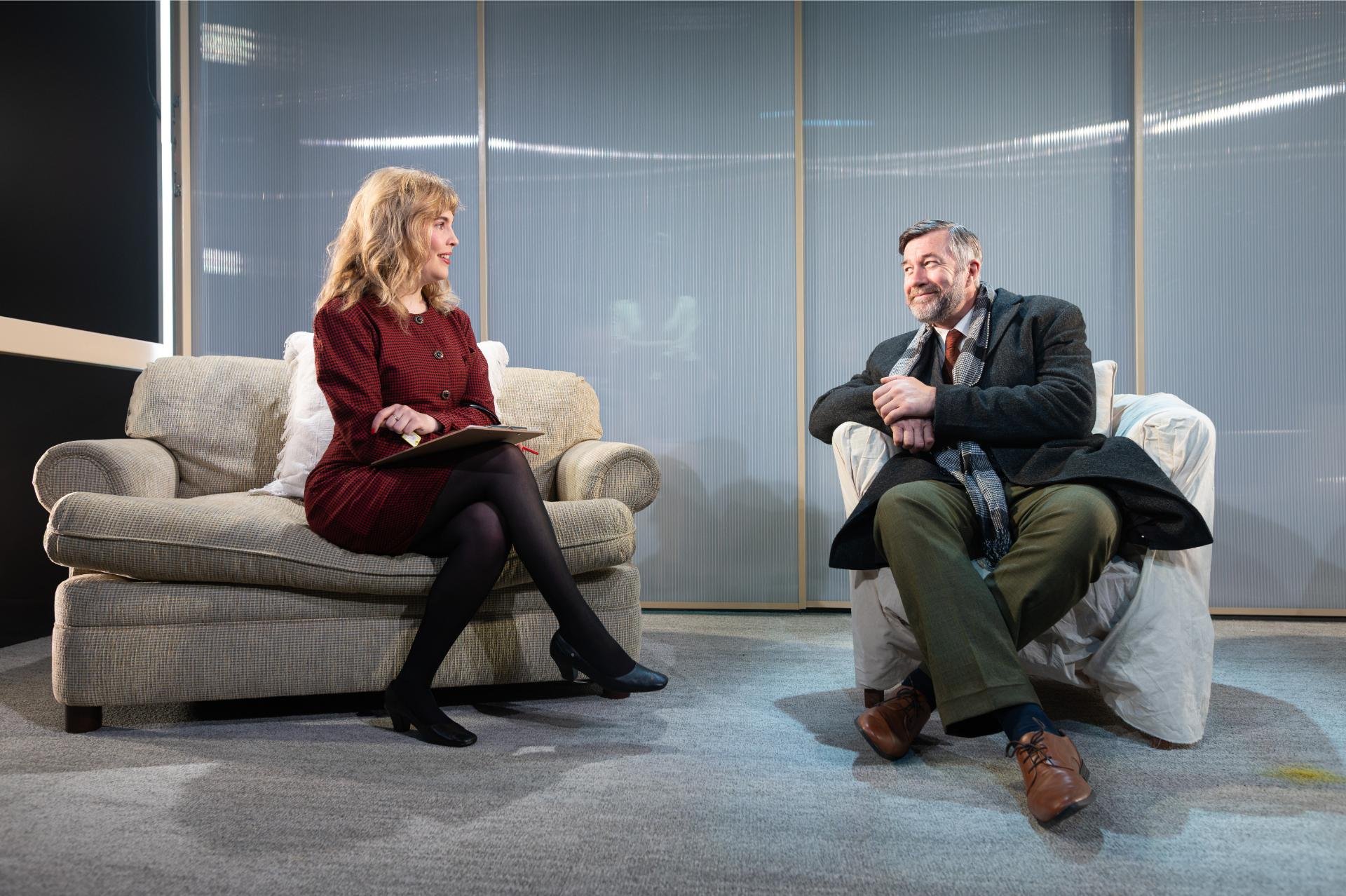
Dealing With Clair sees young agent Clair (Olivia Hall-Smith) attempt to help Mike (Arkia Ashraf) and Liz (Talia Benatar) sell their London four-bedroom for a good price—ideally with their morals and honour intact. In the process, she weathers the overeager buyer James (Daniel Fletcher), keen to close on the home and keener to speak about Clair’s own, of which he has an unnerving knowledge. Inspired by the unsolved disappearance of London real estate agent Suzy Lamplugh in 1986, the play is a masterclass of balance: largely marketed as a thriller, you are surprised to find yourself in stitches right up until its dark twist.
Subverting the image of dodgy real estate agents, Clair is the moral centre of the show. We become acutely aware of her aloneness amongst the greed and aggression of other parties, helpless to somehow stop the scene and save her from awkward conversations. As the mysterious James, Daniel Fletcher provides an warmth that rather than discount his character’s sinisterness only enhances it: when he snaps, it is chilling. Fletcher’s performance is outstanding in its dynamics—humanising and complex. From the back row, you can watch as the audience physically braces for his next move. He and Clair’s relationship is all too recognisable to women who deal professionally with those who believe they are owed affection, personability, a smile; her agency and suspicion is dismissed by his flattery. Hall-Smith is a master of subtlety. Thanks to the proximity afforded by the venue, we catch the minute details of her facial expressions, the acute shifts in her physicality. She brings a sort of measured sadness to the role, a depth behind her cheeriness. There is perhaps a superfluous amount of stilted clipboard and handbag work (lots of picking up, putting down), but I’m nitpicking.
Talia Benatar as Liz has fantastic chemistry (and friction) with Arkis Ashraf’s Mike. Short-fused and soft-spined respectably, the two are constantly at odds with or all over each other. This is a couple you would struggle to get through a lunch with, so painfully London, so expressive, so hypocritical, so insistent that information be relayed “word-for-word” whilst refusing to do so themselves. By the end of the play, our amusement has festered into hatred for these characters. Their stress is only exacerbated by the lax sarcasm of Anna (Jane Fuda), their “Italian girl”, or, glorified baby-shusher. Fuda’s comedic timing is impeccable. The nanny’s silent judgement allows Mike and Liz to dig themselves deeper into a myriad of holes, exposing the absurdity of their social posturing. Bayley Prendergast too acts strongly as an ensemble-in-one, playing Northern handyman Ashley and a perfectly disinterested Italian Vittorio (the distinction takes a moment to click), though as Toby he seems less present.
Larisha Dowson-Taylor’s choice of blazers and pencil skirts balance youth and professionalism fitting for Clair. Also, the hair is gorgeous. Dowson-Taylor’s realistic and effective costumes extend to the rest of the cast: Liz’ cuffed jeans and blouses, James layered in coats and scarves (his clothes both proper and a concealment), Anna sporting various robes and dressing gowns, as per her Italian disdain for getting dressed.
Dialect Coach Linda Nicholls-Gidley must be chuffed: the English accents are convincing from start to finish, and though Anna’s Neopolitan leant more Russian on occasion, the overall consistency is to be applauded. This applies too to voice control and projection. On the whole, the standard of acting is as good as any high-ticket play. I’d not hesitate to bet on the success of these performers. Crimp’s script is full of repetitive monologues and speeches, of circular arguments and dialogue that requires an awareness of naturalistic speech and timing. Reid’s expertise is evident. So precisely choreographed it’s almost percussive, the rhythm injects humour, it controls suspense, it has characters colliding over one another. I have to wonder how brutal the rehearsal schedule was—this performance is polished.
Reid also led the sound design. Reid understands silence, its potency. As the play dances between politeness and explosive aggression, humour and suspense, silence allows tension to breed. We feel just as stuck as Clair does. His direction is considered and patient, to great affect. Where sound is added, it is done so to enhance, rather than distract: a distortion effect as Clair or James speak into the telephone, or, to tremendous effect, the sounds of trains passing timed with eerie swipes of light in the overhead LEDs. Izzy Morrissey’s lighting design is judicious and creative; these bar LEDs prove versatile through strobes, tense flickering, dynamic panning, or washes of police-car red and blue, in addition to the home’s bright interior throughout.
Unfortunately for Soham Apte, the production’s excellence in all other fields ultimately exposes its weakness: the set design. For a play whose plot orbits the supposed attractiveness of a home, it is crucial that we believe what we see is worth an ‘80s £250,000 ($1.6m in 2026 AUD), price gouge or not. Somewhere between Salvos and IKEA, the sofabed, armchair, and small table that form the set simply fall short of convincing. It’s functional of course, and one has to wonder about Irregular Programming’s budget, but ultimately the design simply lacks character and vision. It fails to represent the posh bourgeois who occupy it, fitting more the ‘neutrals’ of Clair’s ‘cupboard’—in which only two scenes are set—and lacking any suggestion of era or class, both of which are central to the script. This neutrality might’ve been amplified as a nod towards moral responsibility—“The walls don’t take sides!”, Clair jokes—or, if minimalism was the intent, perhaps to evoke Liz and Mike’s lack of authentic personality, but the direction is unclear. As is, the pieces feel like non-choices. Given the play’s subject matter, what it teaches us about facades, trust and truth, this production’s design has missed a symbolic and visual opportunity.
It is saved by the excellent use of sliding polycarbonate doors upstage; elegant, perforated panels which the performers enter and leave through to move about the house without the performity of exiting stage left. Liz compulsively taps the panels throughout as she calls for Anna, and characters appear obscured behind it in striking tableau. The performers also make good use of the theatre’s aisle as a faux corridor. For all the lacklustre of its interior, the production does have a convincing sense of a building.
Though I’m hesitant of spoilers, where the play falls flat for me is the ending. The climax of the play, respectably handled offstage to remain true to its mystery, might lean too far into ambiguity at the expense of clarity and emotional impact. The characters—and, in turn, we as a people—are so self-interested to question or indeed acknowledge a moral evil, and it thus makes sense didactically to conclude with a swift moving-on. But is it ambiguous, or just inconclusive? The ending feels underdeveloped, rushed and dragging at once. Whether the blame here falls on the production or the script is unclear, but it’s certainly a letdown for what is otherwise a sophisticated story.
Ultimately, Reid and Irregular Programming have taken a “hateful business” and given us a show to love. The property market is never not relevant, but the current value of this play has very little to do with real estate at all. That may be the plot’s engine, but fundamentally this is a play about human nature. They have done it justice.
Catch Dealing With Clair at The Old Fitz Theatre before it closes 25 July.