
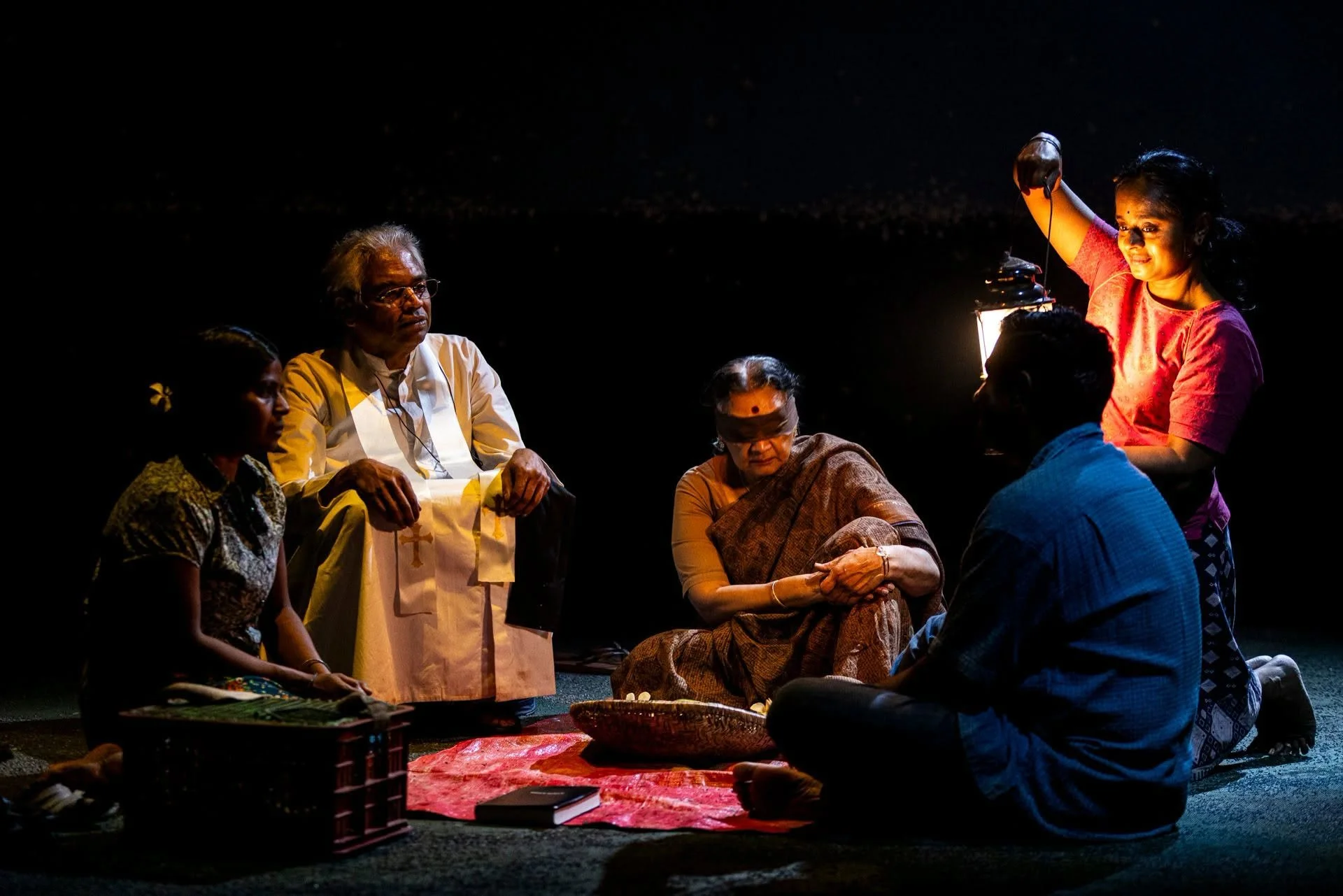
Image Credit: Brett Boardman
By Murphy Scott
‘Perhaps order is just violence… done neatly.’
What would you do to bring your family back together? What would you endure? Are our familial ties strong enough to lead us across fourteen years, through jungles and beaches and bombings, just for the hope we might find someone we’ve lost?
When the house lights came up at the end of The Jungle and the Sea at Belvoir St Theatre, I was, honestly, scared. I didn’t know how I’d write this review. The Jungle and the Sea is one of those shows that is just so spectacular, so massive in its scale and construction and emotion and plot that I didn’t know I’d be able to condense it into a coherent review, even less a coherent review that did this magnificent show justice. I truly cannot sing the praise of The Jungle and the Sea enough.
The Jungle and the Sea, written and directed by S. Shakthidharan and Eamon Flack, returning to the Belvoir stage after a highly-praised 2022 season, follows a Tamil Sri Lankan family’s journey to reunite with one another after being separated following a church bombing from the Sri Lankan government in 1995, as the ceasefire between the government and the Tamil insurgency group, the Liberation Tigers of Tamil Eelam, abruptly ended. The Tamil Tigers wished to establish an independent state in the north of Sri Lanka in response to the discrimination the minority Tamils experienced from the majority-Singhalese government. As youngest daughter Lakshmi (Emma Harvie) and now-blinded father Sivapalan (Prakash Belawadi) flee to join family in Australia, sisters Abirami and Madhu (Kalieaswari Srinivasan and Nadie Kammallaweera) accompany their mother, Gowrie (Anandavalli) on a fourteen-year journey to find brother Ahilan (Shiv Palekar), who has estranged himself from and fled his family to join the Tamil Tigers in an attempt to fight back against the Sri Lankan government. Following Ahilan’s departure, Gowrie dons a blindfold which she vows to wear until her entire family is reunited, leaving her blind for what ends up becoming over thirty years.
Perhaps the best place to start with this juggernaut of a play is the music. As one of the first things the audience sees or hears, it sets the tone for the rest of the play, and what a tone it sets. Musicians Indu Balachandran and Arjunan Puveendran underscore the majority of the play with a variety of instruments split between the two, from a variety of percussion instruments, to a veena, to the performers’ voices, heightening and contributing to the atmosphere of the play incredibly and intensifying many of the script’s already powerful moments. As bombs drop on the characters, loud bangs ring out from Puveendran’s drums, drums which on numerous occasions surprised the audience, shocking me right into the tense and frightening scene the drums accompanied. Every instrument is expertly played and their music wonderfully arranged, and was a personal atmospheric highlight for me (though I really did love every part of this play).
The play is also complexly staged on a near-constantly rotating turntable that no doubt would have been a nightmare to choreograph on. Despite this, every scene flows and and runs smoothly and dynamically, and the unreal atmosphere the turntable (plus Dale Ferguson’s wonderfully simplistic set design) provides allows for scenes to span continents, oceans, and decades without feeling clunky or trite like I find many theatrical montages can be. The show feels constantly alive, humming with energy from the constantly shifting and moving ensemble as they almost seem to dance upon the revolving stage. The rare moments the stage ceases movement are thus intensified in their power over the audience; in their contrast, they create arrestingly engaging moments of meditative stillness. One excellent example of this is the very final scene of the play, as Gowrie is united with her family (though not exactly as one may have hoped), takes her blindfold off, and silently dances before them (Anandavalli is a classically trained Indian dancer!). It is almost impossible to put into words just how powerful this closing moment is. After the near-constantly moving chaos of the rest of the play, this moment of stillness, accompanied by Balachandran and Puveendran’s music, is unbelievably emotional and engaging, and certainly the best way this epic of a play could have ended.
It would be remiss of me not to mention Véronique Bennett and Damien Cooper’s astonishing lighting design (Bennett was the show’s original lighting designer). Most decent theatrical lighting tends to blend into the background, heightening the show but never really asserting itself, so the only lighting anyone tends to notice or remember is either the really good or the really bad, and The Jungle and the Sea’s lighting is so breathtaking I found myself studying it on several occasions. Given the minimalism of the set and the span of the plot; we travel from Sri Lanka to Australia, from war-torn hospitals to fancy restaurants in Bennelong, all across 30 years; the lighting has to do a lot of heavy lifting to help the audience feel immersed in the context of any given scene. While this work is simplified somewhat by a small upstage sign that is updated to show the year, plus small miniatures of planes, trucks, the Sydney Harbour Bridge, etc. carried by stage hands and cast members to show where we are (which I found delightfully simplistic—they worked well with the show’s non-realist elements and allowed the play to ignore the need for expository dialogue regarding the context), the lighting is what really seals the deal, and it does so wonderfully. From the stark white star-shaped lighting of Lakshmi’s graduation dinner with her appa, to the bright warm daylight of the family’s early, pre-split days in Navali, Bennett and Cooper’s lighting design never failed to heighten scenes, creating rich and beautiful tableaux that did justice to Shakthidharan and Flack’s incredible script.
This script was also, most importantly, brought to life by an astonishing ensemble cast (including, alongside previously mentioned actors, Dushan Philips and Rajan Velu) that deftly shifted from role to role as required, bringing depth and nuance to every single character they portrayed. My absolute highest praise has to go to Anandavalli’s Gowrie, the beating heart at the core of the play. Anandavalli carried an astonishing weight and presence every single time she was on stage (which was a lot of the time!), expertly balancing a matriarchal sternness and strength and a maternal warmth, throughout all of which ran her quietly humming desperation to reunite her family. While the entire cast was amazing, Anandavalli’s performance was nothing short of miraculous. The depth of emotion she brought to Gowrie and the stage as a whole deserves the highest commendation.
The Jungle and the Sea is an arrestingly powerful meditation on family, war, violence, and what we will do to protect and reunite with the ones we love. It is also an incredibly poignant depiction of a devastating civil war that manages to deftly wrestle the ethical conflict between the two sides without ever flinching away from depicting the horror a war like the Sri Lankan civil war entails. Really, I think the best way to get an audience to emotionally connect with and understand something as large as the Sri Lankan civil war is just what Shakthidharan and Flack have done: to focus on the story of one small family, distilling the experiences of hundreds of thousands of people into a shockingly effecting and engaging microcosm. I truly cannot recommend this play enough.
The Jungle and the Sea runs at Belvoir St Theatre until the 2nd of August.