
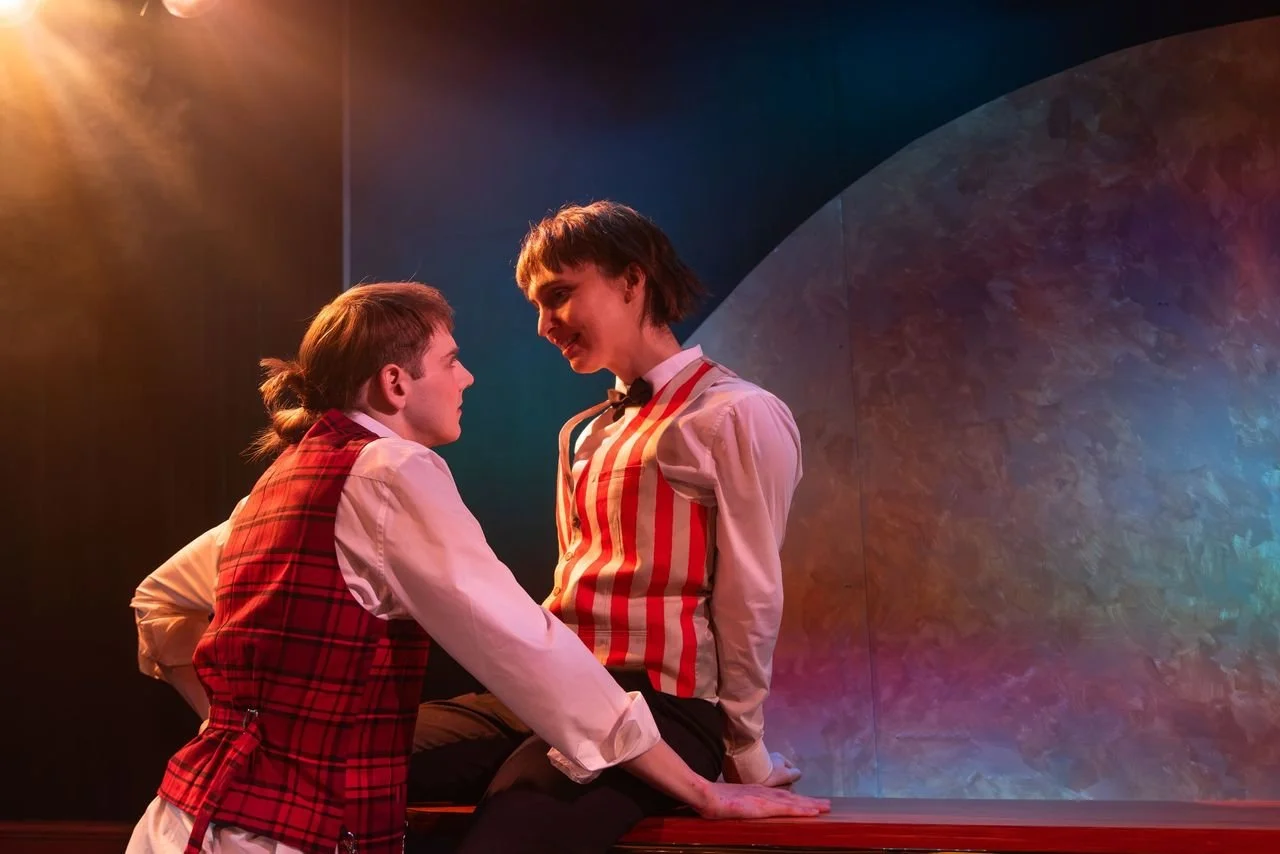
Image Credit: Lucy Parakhina
By Murphy Scott
From the moment the lights go up on Afterglow, I knew I was in for a musical treat. A voiceover situates our characters in a 2012 bi-annual barbershop convention, and our main quartet, ‘The Barbershop Boys,’ step on stage and leap right into the music, singing a beautifully arranged and excellently performed classic barbershop-style song.
Set across three barbershop convention after-parties (‘afterglows’) across 2012 to 2016, Afterglow, written by Sheanna Parker Russon and Lillian M. Hearne follows the romance and individually emerging identities of Michael (Cassie Hamilton) and Tom (Nic Prior), a young, nervous, and clearly talented barbershop purist and a reserved newbie looking to shake up the traditionally all-male barbershop environment, respectively. As the two debate the merits of introducing non-male singers into barbershop, they find themselves drawn to each other, finding a romantic and personal connection in their shared insecurity in their identities and discomfort in the expectations thrust upon them as male-presenting individuals. Though Michael initially resists the two’s connection, clinging to the veneer of heterosexuality the masculine barbershop scene demands, Tom (becoming ‘T,’ and eventually, Parker) never fully immerses themselves in barbershop, instead exploring their gender fluidity, become more and more comfortable in their skin as the years go by, while Michael remains stuck in the repressive masculine confines the barbershop community insists upon.
Music remains a constant throughout the whole story, with the Barbershop Boys singing classic acapella tunes together between the more emotionally-driven non-diegetic songs, including a wonderfully choreographed tango between Michael and Parker during the initial 2012 afterglow as the two debate the merits of the arguably homophobic and misogynistic macho-atmosphere that the men of barbershop seem to encourage.
These musical elements are, technically speaking, flawless. Wonderfully composed and arranged, the music throughout the show, especially the acapella pieces, were a delight to watch and listen to. Every single cast member had crystal clear voices that glided right through even the more difficult vocal parts the musical boasted. I truly cannot fault this cast’s musical talents, and my only real complaint is that there wasn’t more acapella, with much of the non-diegetic pieces in the latter half of the show supported by Hearne on piano, which, while well-played and musically beautiful, did leave me missing some of the acapella ditties from the first half.
The show’s technical elements are also to be praised: Geita Goarin’s costuming, especially for Parker, was wonderful and were well-constructed, and Tyler Fitzpatrick’s lighting design helped ease the audience into the afterglow’s boozy late-night atmosphere. The staging of the show, from directors Hamilton and Lily Hayman and dramaturg Jean Tong, was wonderfully fluid and managed to feel natural without feeling stale.
The book and lyrics are where I began to find the show lacking. The dialogue at many points, especially during Michael and Parker’s political discussions, felt clunky and unrealistic. As the two bounced between terms like ‘bleeding heart liberal,’ and Michael called Parker’s ‘leftist’ politics ‘asinine’ during their tango, I couldn’t help but think to myself: did anyone in 2012 actually speak like this, especially while drunk in an informal context? It made any political discussions throughout the show feel hamfisted and unsubtle, and it seemed as if Russon had put very little effort into making Michael’s arguments (which she clearly disagreed with) feel at all sincere in their construction.
Furthermore, throughout the first half of the show, Michael has a habit of turning to the audience in a sort of Fleabag-esque delivery of his inner thoughts (plus a bit of expository narration), which, while a nice concept that one might think would pair well with some of Michael’s non-diagetic songs, I found to be executed poorly and somewhat awkwardly, with attempts at humour that for me largely fell flat. These interjections also seemed to almost completely disappear in the final chunk of the show, as Michael has become Michelle, coming to terms with both her sexuality and her identity as a transgender woman, returning to the barbershop scene for the 2016 convention after all but disappearing after the 2014 convention (a disappearance which is shown through a very touching montage of Michelle’s quartet members, Matt, Rupert and Trevor, respectively played by Lincoln Elliott, Nic Jobe and Hearne, calling after her and telling her they care about her). While it could be argued that Michelle’s breaking of the fourth wall in the first half of the show stemmed from her insecurity in her own identity that is remedied by her transitioning, their absence still felt more like Russon and Hearne simply forgot about Michelle’s habit of talking to the audience, rather than an intentional choice.
A forgetful tendency seemed to permeate the whole script; many moments of character development seemed to happen almost entirely offstage, as Michelle’s once conservative and macho teammates Rupert and Matt reconcile their misogyny and homophobia almost entirely offstage, and their ultimate acceptance of Michelle’s transition occurs entirely offstage. Given how much of the first half of the show focuses on the issue of women in barbershop and how much Michelle and her quartet members reject the notion, it seems odd that their eventual acceptance of a woman into their quartet is completely skipped over. While some time is given to exploring the remnants of misogyny that remain even after Michelle’s transition, the way the show skips it over feels rather unsatisfying.
Furthermore, I think Michelle’s fourth-wall-breaking interjections fell flat in part due to the script’s general shakiness in writing quality, though I unfortunately don’t think that they were helped by Hamilton’s performance. While the rest of the cast were stellar all around, Hamilton’s strength seemed to rest moreso in the musical realm, as her acting felt to me a little overdone and unrealistic, almost cartoonish in her depiction of Michelle’s initial awkwardness. This is not to say that Hamilton is a weak performer, she still managed to handle the show’s emotional moments well, and her nervousness was at points rather charming, just that her performance contrasted a little awkwardly with the rest of the cast’s more grounded performance.
A shining example of these more emotionally grounded performances is in a scene between barbershop basses Rupert and Parker during the 2016 afterglow, following Michelle’s official coming out and Parker’s recent separation with their long-time partner. Rupert tenderly encourages Parker to finally pursue Michelle, delivering this heart-to-heart through a tactfully-written metaphor about hotel buffet breakfasts. This was by far my favourite non-musical moment of the whole show, as Jobe and Prior delivered performances brimming with emotional nuance and depth that I found incredibly moving.
At its heart, Afterglow is a small intimate musical experience that, despite its flaws, is heartwarming and moving and a rather beautiful exploration on how one’s burgeoning queer identity can be hard to come to terms with in an environment that rejects queerness entirely. Plus, it’ll leave you walking out of the theatre with a newly minted itch for acapella.
Afterglow plays at Belvoir’s Downstairs Theatre until the 25th of July.