
Image Credit: Daniel Boud/Sydney Theatre Company
By Myan Vandegraaff
Jane Harrison (Muruwari) has taken on the heavy task of repositioning the public knowledge of one of Australia’s most contested historical figures in her newest work Bennelong in London. The one-act work, developed in association with the Sydney Theatre Company, begins in the home of actor Sebastian as he rehearses and records a self tape for the role of Bennelong in a play of the same name. After struggling through what he identifies as the ending monologue, Sebastian flippantly calls upon the spirit of Bennelong to assist him in his characterisation. Then suddenly, and quite comedically, Bennelong himself opens the door to Sebastian’s home. What arises from this conversation between an Indigenous man living in 2026 and the spirit of a long-passed and well-known Elder is an exchange of knowledge. Bennelong agrees to help Sebastian with his character study, so long as the story is told in Bennelong’s words.
Harrison as a writer has never shied away from the practice of framing history for what it is; we have been blessed to witness it in her previous works Stolen (1998) and The Visitors (2020). Though Bennelong in London boasts the same honesty and rawness as these prior feats in its ability to tell historical events through an Indigenous perspective, it also signals a shift in the writer’s authorial process. While her other plays are pieces of historical fiction that have their basis in the study of shared historical experiences, wherein true stories are amalgamated and retold by largely fictitious characters, Bennelong in London offers a rich and detailed biography of one historical figure. Within this work, Harrison ventures to humanise Bennelong with a level of patience that is not often afforded to the figure. Due to his relationship with British settler and Sydney governor Arthur Phillip and his subsequent exploration of European ways of living, he has been seen as a compliant traitor by many Indigenous people. Simultaneously, due to his later rebellion against Arthur Phillip and the colony, and his engagement with traditional practices deemed as violent by British settlers, he was ultimately branded a dangerous and immoral individual in their eyes. Bennelong in London, however, takes audiences through all iterations of Bennelong, carefully arranging the misaligned puzzle pieces of his story until it formulates the complete image of a man who, in Harrison’s words, may be both a devil and an angel, but is ultimately just that: a man.

Image Credit: Daniel Boud/Sydney Theatre Company
Though the play is a simple two-hander, the stage feels full at all times. Googoorewon Knox (Gamilaraay) portrays Bennelong with such thoughtful tenderness, completely embodying each emotional beat with utmost conviction. Guy Simon (Biripi Worimi/Wadi Wadi/Walbanga) catches the responses made by Knox to each emotional beat and reflects them as seamlessly as a mirror to a beam of light, allowing the chemistry between the two actors to create a synthesised world of storytelling right before the audience's eyes.
At times the work loses its stride due to the breadth of information covered, and the overload of information can become slightly fatiguing. Similarly, in many moments throughout the play, Sebastian’s character seems to serve as little more than a device through which the story is coaxed out of Bennelong, rather than a fully-fledged individual in himself, which can occasionally lead to a lull in the relationship between the two. Perhaps the pacing can be refined in order to balance this out. Ultimately, however, the work is largely immersive, with the natural narrative of Bennelong’s life being entirely gripping.

Image Credit: Daniel Boud/Sydney Theatre Company
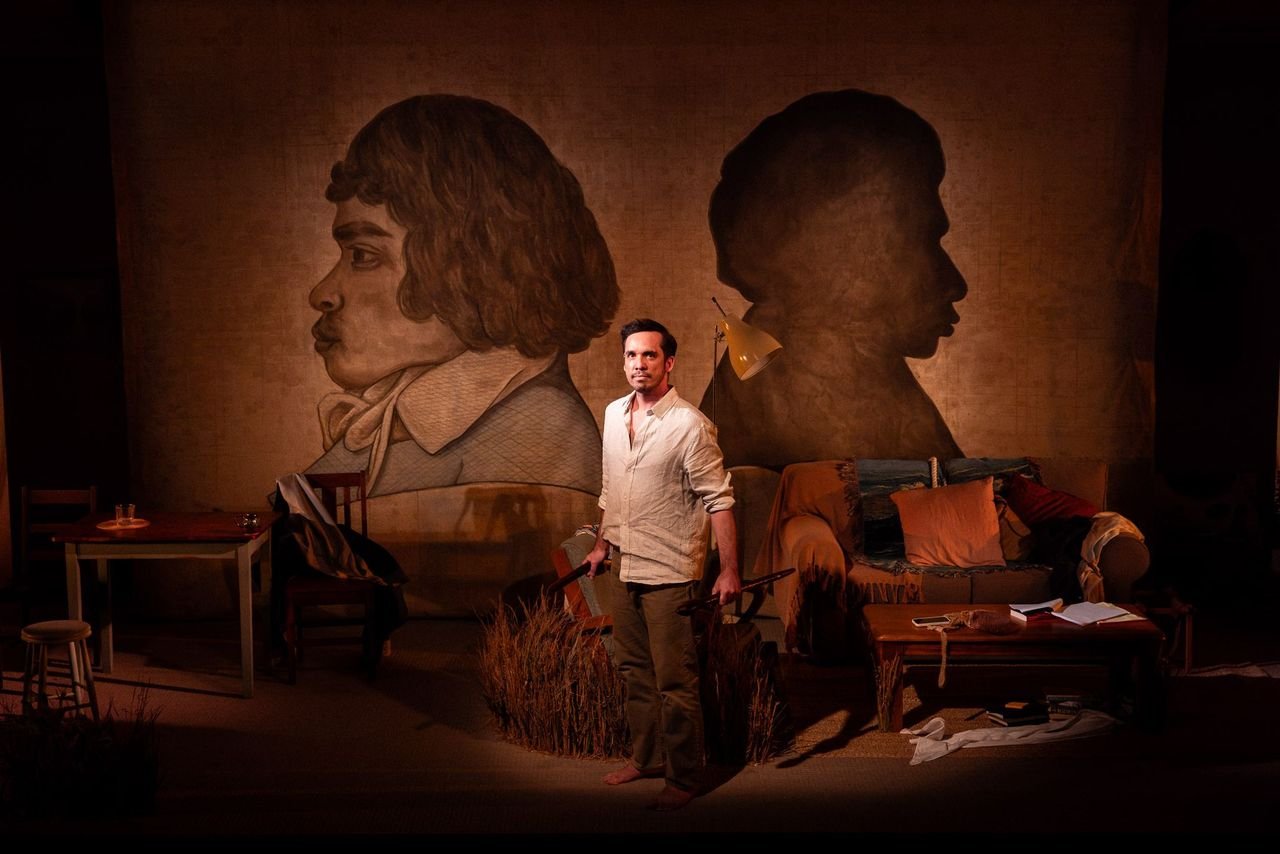
A standout element of this production is the set design crafted by Emma White. There is such mastery in every single visual choice that for the first few minutes upon entry, all one is able to do is admire it. It functions almost as a painting set in the middle of the performance space. A sloped ceiling and diagonal curtains on either side draw focus towards the very centre of the space. The main feature of the set is the interior of Sebastian’s house, behind which two windows to the outside of this world reveal a clothes line. Lining the space is native Australian flora, mixed in amongst the many books and pieces of art that sit in perfect untidiness. The space is so subtly lived in, combining elements of everyday life that, while not interacted with, communicate to audience members relevant information such as Sebastian’s character and his basic interests, the general timeframe in which the play is set, and the various subconscious tendencies that Sebastian may have. A certain complexity is thus afforded to the play through this set design that assists the script in moments where it does falter in its pacing.
Bennelong in London is an ambitious work, but it is also a necessary one. What we have here is Harrison’s creative contribution to an ongoing conversation surrounding who has the authority to tell Indigenous stories, and the means through which they are told. Bennelong’s insistence to have his story expressed in his words speaks to the colonial genocide on truth-telling and self-expression of First Nations peoples. Here, Harrison reclaims the story of Bennelong, asserting the right for it to be told in complete truth. Bennelong in London raises its voice among a culmination of generations of voices who, in the face of historical, cultural, political, social, and creative repression, are screaming to be heard.