
By Cormac Herron
This is not a review. This is a love letter to Samuel Beckett. I don’t write love letters often, but I have to break tradition for this show, so humour me. If you’re looking for a neat description of the piece that explains it and its meaning you will not find it here.
I couldn’t sleep two nights ago. I sat in darkness and noticed the rare drone of tinnitus I get in my right ear: you value your hearing more after being born deaf. A joint in my hand had flared up and it hurt to use it. At least my cough had subsided. I’m young, but lately, I’ve been getting reminded that despite my age, I’m not invincible. That night, before I failed to sleep, I had been revelling in the ‘choose life’ monologue from Trainspotting. Lately, I’ve been trying to remember to ‘choose life.’
A close friend of mine and I sat across from each other at the pub before the show. We both want to act. We had one of those conversations that wasn’t remarkable, but after it, I got the strange feeling I’ll remember it distantly for years to come. We were talking about a whole range of things but we were really talking about our hopes and dreams. We’re young; it’s natural to have those.
At the risk of being any more obvious, the proximity of death and the future have been on my mind lately. I’m not overly superstitious, but it feels like I’ve been put in that direction for a reason, and I think it culminated in watching this show.
So, we walked into the theatre; we started down the rabbit hole. The lights dim, we’re swept into darkness, and there is a great wind; we’re not in Kansas anymore.
Happy Days by Samuel Beckett is best described as a reminder of the closeness of death, how dangerous monotony is, and how quickly time creeps up on you. I raised my wrist to look at my watch and realised it’s been forty minutes. It dawned on me that I could’ve been here for days and I wouldn’t have noticed because I was enamoured by the desperate death rattle before me. That scared me. It’s not often you go from talking about your dreams for the good part of your future to watching the very real possibility of the bad part; the part where every day is the exact same and nothing changes and you feel like you’re suffocating and no matter what you do there’s no going back.
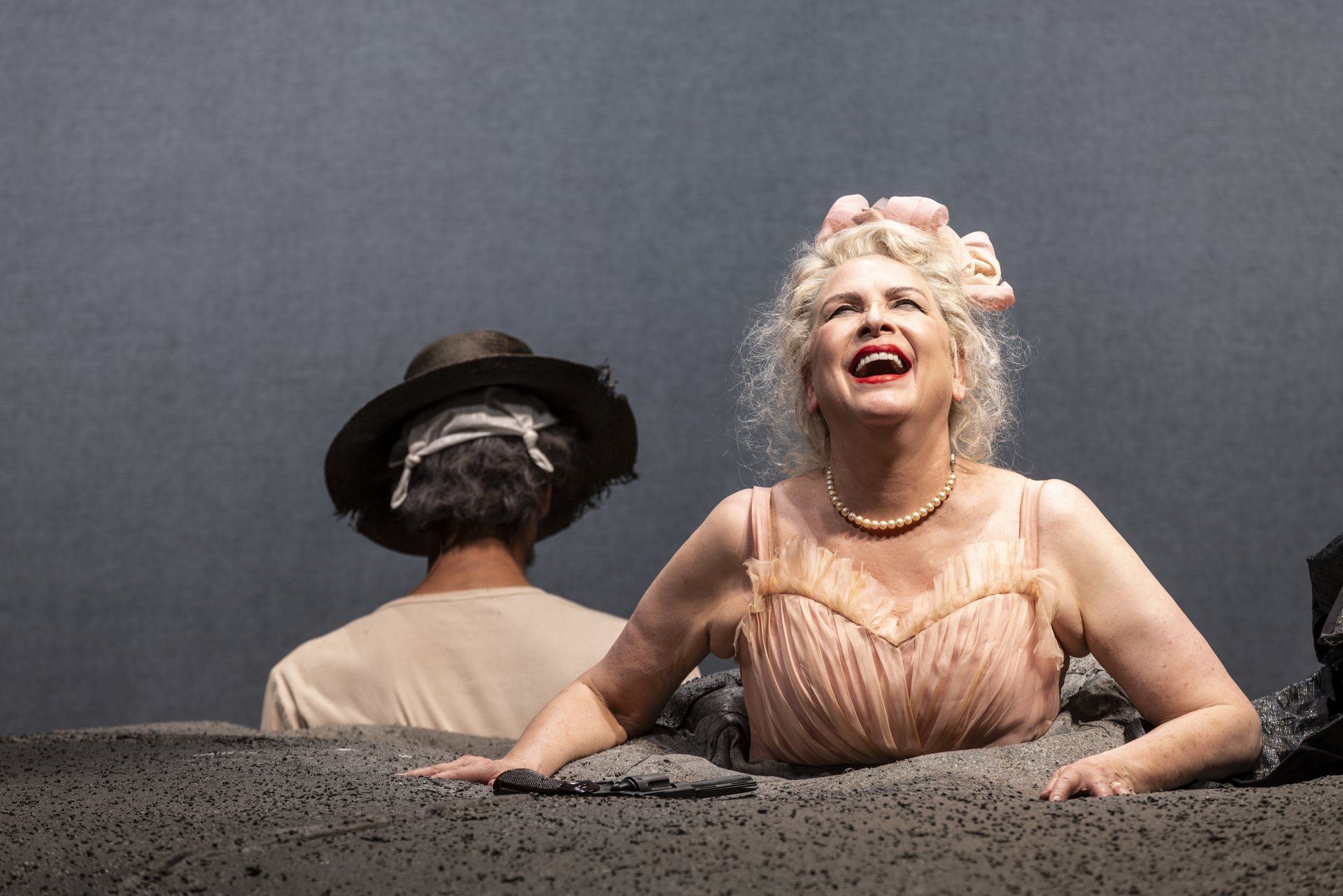
Before me is Pamela Rabe as Winnie, up to her chest in a mound of dirt that takes up the entire stage and can’t get free. Despite being stuck in place, she manages to expertly give her performance. She has the rare kind of face where every single emotion can appear on it at once. Winnie’s husband, Willie, sometimes stands on the other side of the mound, occasionally giving monosyllables and grunts as he’s turned away from the audience. Played by Markus Hamilton, the back of someone’s head has never been more expressive. Watching a wiry man trace his hat and flick through his newspaper hasn’t caught my attention before, but Hamilton made me hold onto it each time.
Mastery breathes out of the pair’s performance, which is strange, because what I watched was an absurd play, it was nothing, and yet, it had my full attention, my smile wouldn’t break. Everything that Winnie and Willie did was measured, not with the kind of precision that you get from practice, but the kind you get from years and years and years of living the same day, which is exactly what the couple had done and would continue to do.
I couldn’t take my eyes off the staging throughout. I had this weird sense I was about to watch Video perform the public execution of the Radio Star. Nick Schlieper’s set notably contained a literal frame through which we watched Winnie and Willie and behind them lay a sky-blue screen. After looking at it long enough, it started to seem like it was unsettlingly tessellated, like what I was really watching was a pair of caged animals before tiled walls. In the centre lay the implacable, ageless, timeless mound of dirt, representing nothing more than itself. As my eyes grazed the layers of the mound, I began to think that not only had my hearing failed me but also my eyes. I could’ve sworn there was a mirage, what, with the illusions of the sky-blue screen but now the light upon the mound was shifting. I liked this disorientation, like I was only just as lucid as Winnie was.
The second act was even better. Winnie was now up to her head in dirt, leaving her face, and importantly, her eyes to work with. They slammed from side to side in their cages with such intensity. I began to wonder if I could ever do such a thing, and to think that her performance was still so powerful. Rabe’s performance toed the line between lucidity and delusion perfectly, returning me to realities I’ve experienced, reminding me of how little I’d like to end up like that.
Grimly, I found myself noticing how old the audience was. When they stopped laughing at the jokes Winnie was making – jokes you can only make and really get at a certain age – I wondered if it was because they saw too much of themselves in Winnie and Willie. I wondered if Rabe and Hamilton had scared them more than they had scared me.
The problem with performances and plays like these is that words can’t quite capture what I’ve seen. Yes, I can give simple qualificatory expressions, saying that “I loved it,” which is true, but that wouldn’t be quite right, it doesn’t do it justice. In some weird way I think this makes sense, because every single thing you watch on that stage, every single word uttered, is meaningless, and so the only way that I can really give this review is to tell you how it made me feel, to give Beckett my love letter.
Happy Days is playing at The Wharf 1 Theatre until the 15th of June.