
Image Credit: Prudence Upton
By Sarah Zeppel
What is it like inside the House of Parliament? Sex scandals. The ruining of dreams. And not a lot of political action.
Housework, written by Emily Steel and directed by Shannon Rush, is a hilarious and painfully real representation of issues within the Australian parliament and a reflective critique of struggles such as; being a mother whilst having a demanding career, the discouraging treatment of young women in politics and much more.
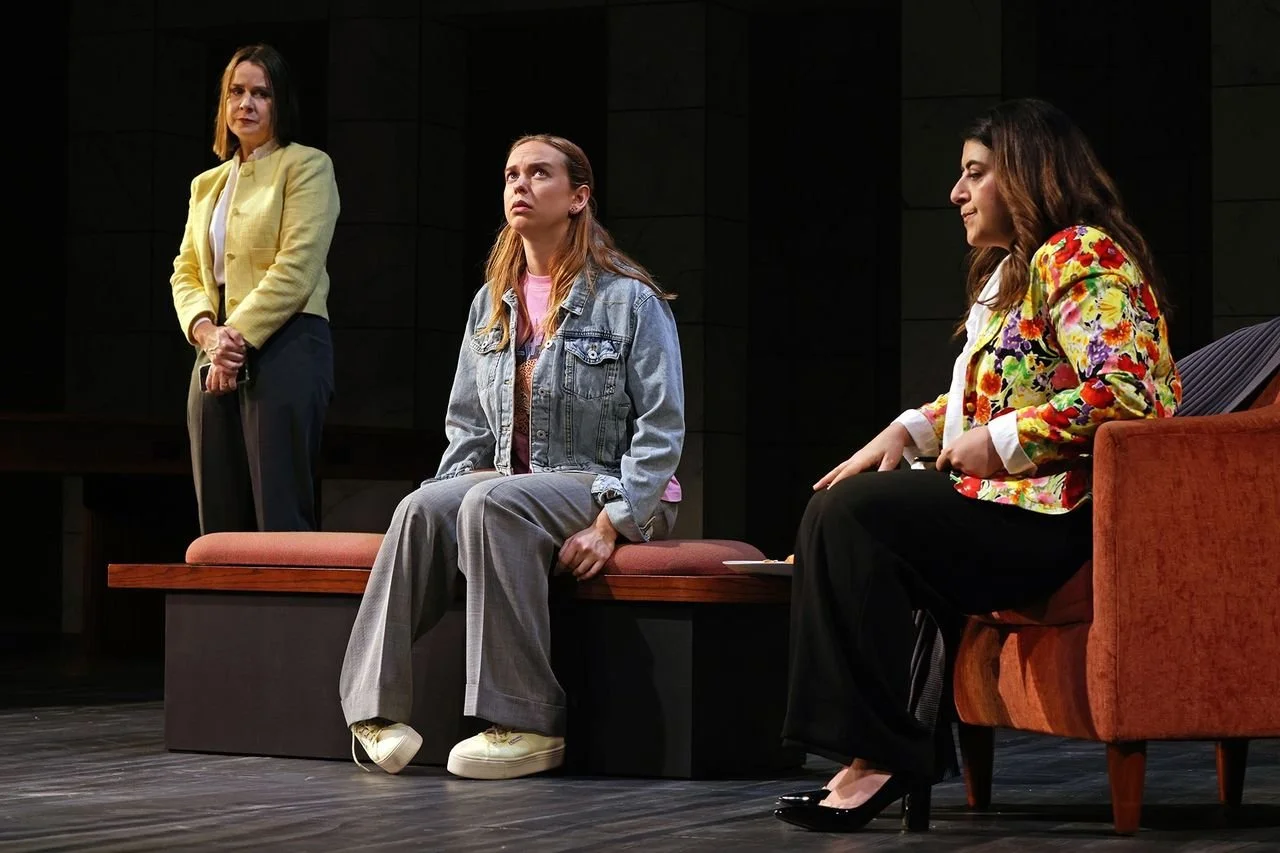
The story follows Ruth Mandour (Susie Youseef), a newly elected, passionate MP and her team, including Anna (Emily Taheny), her Chief of Staff, who struggles with her frustration and jealousy of Ruth’s success and the lack of her own career progression. Ben (Laurence Boxhall) the sarcastic Media Advisor, who, after falling ill with Covid, has Kelly, a new junior staffer, replacing him on their trip to Parliament.
Act 1 lulled the audience in, with familiar characters via exaggerated and engaging characterisation, with the repetitive auditory experience representing transitions similar to a sitcom style with the shared precise comedic timing. Act 2, however, engaged the audience with the fast pace of the second act and was accompanied by a great uncertainty of what would unfold. Act 1 was used to develop the audience's understanding of the characters and who they represented, particularly the passion of Australia's younger generations embodied in Kelly, via her care and drive to improve Australia, which was rarely shared by the others.
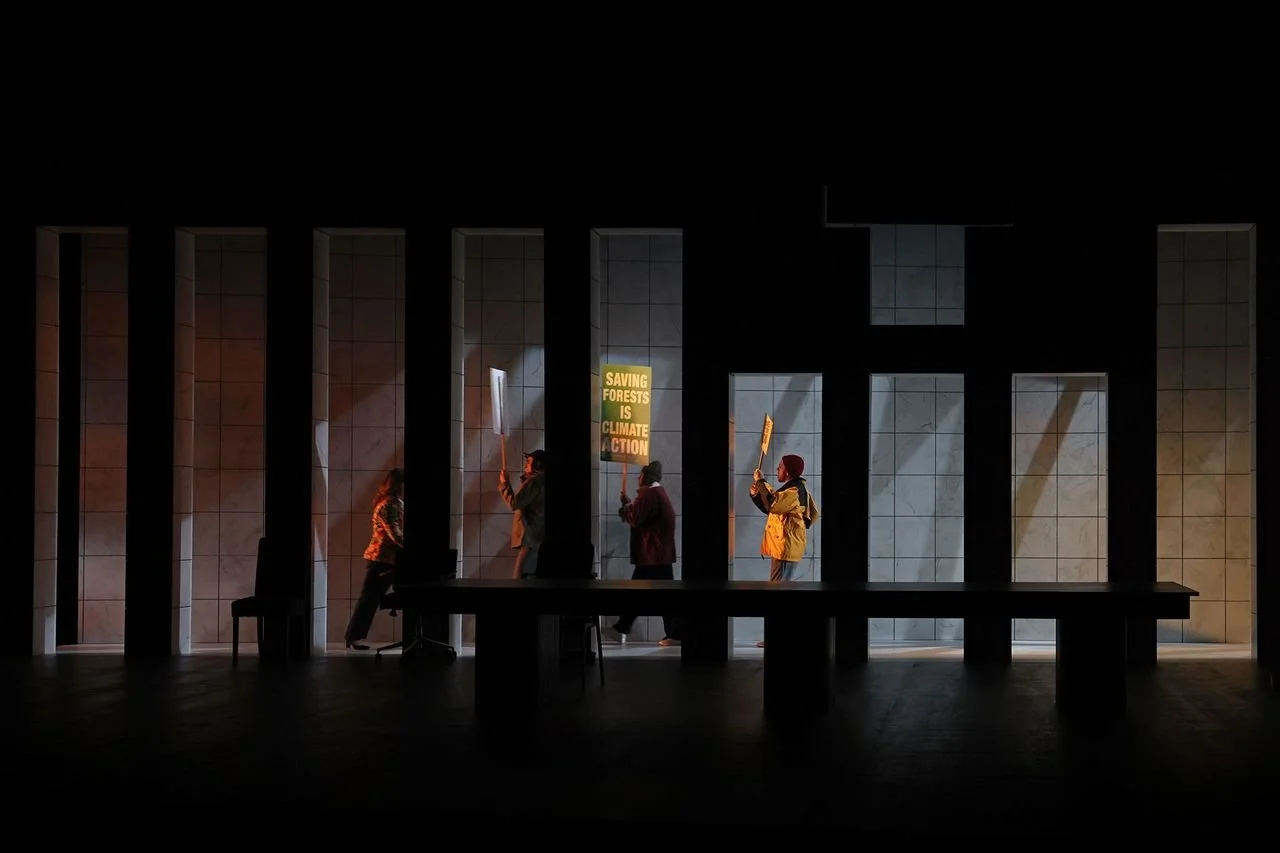
Image Credit: Prudence Upton
Many of the actors played multiple characters, which expanded the world of the performance while also allowing for comedic moments and enhancing the overall performance. A significant moment of dual casting occurred when Indira Naidoo, acting as the Prime Minister of Australia, took on the role of a cleaner with minimal dialogue, who would constantly appear during moments of transition and reflection. There was a beautiful and meaningful use of scene transitions, as we saw the environment of Parliament, who is needed to make it function, and who must make sacrifices for the system to work. This act re-interpreted the allure of politics by highlighting the unseen labour, often conducted by women, people of colour, and of course, immigrants, required to maintain the political system.
Discussing with the actors after the performance revealed that the playwright had travelled and spent time in Canberra talking to politicians; this was portrayed via the relevant dialogue and the different characters' approaches to making legislative change. The first act was similar to a sit-com, whereas the second act felt as though I was watching an existential break-down of Australia's governing system. As someone studying Politics, Philosophy, and Economics at the University of Sydney, I recognised how the play effectively critiqued the manipulative social side of Parliament.
The characters represented different versions and generations of feminism and female empowerment. It challenged the common notion that we must ‘play according to the men’s rules’ to enter the system and ‘take it down from the inside’, as often that does not cause real change but instead perpetuates and supports the system. This is emphasised through costuming, where Kelly, the young staffer, wore Anna’s clothing, representing how Kelly was seen as a younger version of Anna, who experienced the same manipulation and predatory experience as Anna, by the Minister for Science, Paul (Johnny Nasser). This caused the character to realise nothing has changed and it won't with them. Whereas Ruth, the MP, had vaguely similar values to those of Margaret Thatcher, not in the sense of political policy, but how a woman must act to succeed in the ‘boys club’ of parliament. Must you give up your empathy, passion for change and femininity to succeed in politics? I’m not sure anymore, but watching this play challenged my current expectations around solutions for fixing corrupt systems. Is it better to enter and try to fix a broken system, but possibly corrupting yourself in affiliation or is it better to leave the lion's den whilst you still can (and not go back for your hat!)?