
By Olivia Zaia
Thus, Sydney Fringe Festival closes its curtains for another year. Gia Ophelia (JB Theatre), a veteran amidst the program’s brand-new acts, returned in 2026 for a two-night victory lap in Lane Cove, after winning last year’s Emerging Artist Award. Writer Grace Wilson says the show was written with Sydney Fringe in mind. Sitting in the Pottery Lane Performance Space’s black box, with its community centre surrounds and just-barely tiered seating on rainy Sunday night, it fits the bill.
TAFE-trained actor Gia (Annie Stafford) is on the cusp of her thirties. We find her pulled between success and failure, stability and freedom, having spent the last decade doing TV commercials and student films between café shifts. The dream that she might ever “be art” is hanging on by a thread, one gnawed at by her Crypto-bro boyfriend Dan and his mother, who, ignorant to her struggles with infertility, demand that she settle down and start a family. Even if she could, Gia has no desire to be a mother, no desire equal to that of playing Ophelia. Ever since Gia’s highschool production of Hamlet, the character has remained “in the wings” of her life—as two women denied agency, they understand, perhaps even need, one another. Now, before she ages out, Gia’s determined to reprise the role through a paid acting residency in Queensland. With no fourth wall, the play attempts to navigate the arts, gender roles, mental illness and ambition through a sharply self-aware, and frequently tender, satire.
Annie Stafford is one to watch. She does a thorough job of expressing Gia’s earnestness, her cynicism, her cockiness and self deprecation; she’s above pretentious dramaturgs whilst desperately seeking approval from them. The opening reads like a well-timed stand-up routine, as Gia panders to an audience clued in to all things AFTRS, Bell, STC. Grace Wilson’s script is, certainly for the first half, delightfully detailed with referentiality in a way that feels refreshingly local complemented by Gia’s Sydney accent.
It does at times risk trying too hard—joking that satay noodles are supposedly pretentious, for instance, just doesn’t land with an audience fresh off a Longueville Road Thai dinner—and Stafford’s relentless eyerolls and scoffs teeter on irritating. But that’s the character, and Stafford commits to the character. Her range is evident; subtle gestures (pulling undershirt sleeves over her thumbs, courtesy of costumer Geita Goarin), add texture amongst loud, exaggerated physicality (i.e., moaning during a downward dog, a manic dance break). I’d be remiss not to give the doona work its flowers too. To wrap yourself in a blue doona for a good chunk of the play and deliver a performance that isn’t static, or doesn’t make me wish I was asleep, is impressive. Jo Bradley’s direction paid off here.
Stafford’s vocal control is particularly enjoyable as Gia impersonates her boyfriend, or the RADA grad-yoga instructor-dramaturg Dot, or the Brisbane barbie Sadie in her Lorna Jane, all delivered with distinction and confidence. Wilson and Bradley have done well to prioritise present-tense action with this wider character cast, avoiding getting bogged down in fruitless introspection. One scene, in which her desperation to impress Dot and land Ophelia mounts, should be added to Stafford’s reel immediately; Gia constructs a montage of character voices, jumping and flinging herself around through frustration and euphoria, so outrageously entertaining.
All the while, Otto Zagala’s compositions and sound design (what Gia calls “that drumming shit”) layer muted basslines and drum hits with brushes on cymbals, with Dot’s singing bowl leitmotif, all becoming more frenetic as Stafford’s pacing and panting does too; the performance is just as percussive as the music. I appreciate such a cohesive approach to sound and production here as well as throughout—the score is present enough to feel meaningful rather than decorative or distracting. With all this noise bolstering Gia’s hopes for Ophelia—and with it hopes for her career, her youth—the news that she has not, in fact, landed the role arrives quiet and empty.
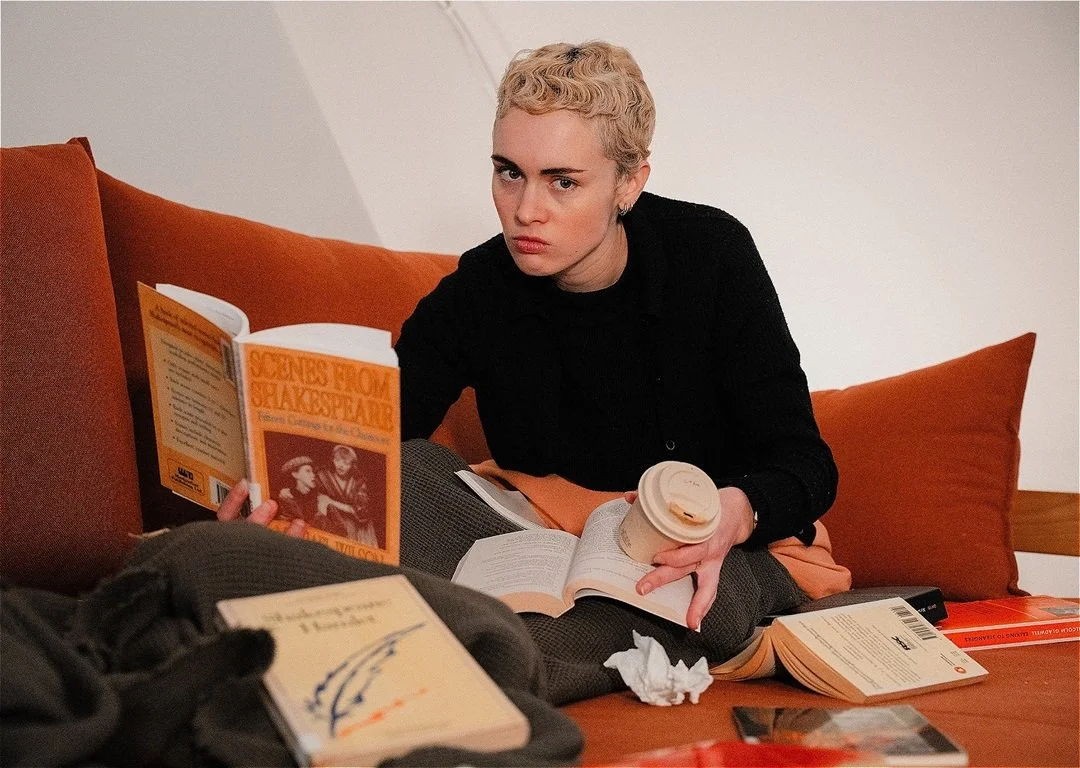
Perhaps limited by the space’s size, the production generally was relatively stripped-back. The set, designed by director-producer Jo Bradley, suggests Gia and Dan’s basement in Rushcutters via a mattress, milk crate, and dozens of strewn-about playscripts, Shakespeare companion texts, and annotated Hamlets. The existing black box stage is then cleared to function as just that for the acting residency, decorated with a little stool and rug, which works effortlessly. The aisle itself gets some use, as we become eager actors in the round, greeted by Gia-as-Dot.
An orange spotlight followed Gia at this moment, before turning off mistakenly. Stafford, honourably, attempted to address the hiccup in character (“Nooo, my spotlight!”), which would’ve been excused if there hadn’t been another lighting miscue, this time randomly strobing and going dark during the play’s tense resolution. For the most part, Julian Dunne’s lighting design was functional however: spotlights, apt for something so metatheatrical, were frequent but successful and worked well beside dim blues for Gia’s bed-dwelling, classic warm white ‘stage-lighting’ for the studio scenes, and the occasional stark wash—Gia is lit in ghostly, clinical white as she demands of us, “Look at me.”
The play lost me a little at the ending. After being cast as Gertrude, Gia’s call to Dan breaking the news ends in the surprise reveal of her infertility, the ambiguous ‘secret’ she’d been carrying since 16. Dan’s abandonment sparks a panicked spiral into pure anger as Gia breaks down, crawling about the space, throwing her books. Something about the outburst and ensuing reflection just doesn’t convince; having lost all of its characteristic satirical edge, the play then drags. Gia sulks, quits the residency and resigns to “lie here”. There are some moments of power—Gia, heartbroken, realises, paradoxically, “I’m so mature I have to be the mother. I have to be the mother.” But broadly, the “mutated” grief of infertility is mostly told, not felt. This is not to say it was an affective failure by any means, just that it didn’t equal what so far had been an extremely present, embodied performance by Stafford. Regardless, at no point in the play does one wish it were a two-, three-performer cast instead.
I do wonder what innovative stagecraft might have come out of having Ophelia be a physical presence in the production. Which brings me to my main grievance.
To scaffold a play (and for Gia, a career) around a character to then barely engage with it is disappointing—and I’m not sure that it carves enough creative space or has a strong enough story-identity outside of that intertextuality to excuse its shallowness. There’s no need for a dissertation, but I believe the audience who bought tickets to a show titled Gia Ophelia could be trusted with a little more… Ophelia. Would a quote have been too outrageous to include? A rosemary for remembrance, a noble mind here o’erthrown? Could we not have seen Gia’s Ophelia in action, acting out a scene, convincing us of her calling to the role?
As it stands, despite Gia’s protests that she understands the character’s complexity beyond “the girl with the flowers,” that she gets her darkness, her suicidal ideation, all we are given are general statements about grief, unpolished monologues that skim the same superficial understanding Gia claims to surpass, and 15 seconds of Andrew Scott’s to be, or not to be played from Gia’s laptop. Ophelia is valorised almost blindly. In claiming to be capable of giving her a voice, she remains voiceless. Gia’s obsession is told rather than shown.
Refusing to be Gertrude, Gia calls the program a “waste of time to pull a muscle playing space jump, waste of money to be told I’m old.” We are given no other conclusion, no progression into some more potent arc, only underbaked catharsis and a clinging to Ophelia regardless. The play is supposedly a censure of ageism and sexism in the arts, but these aren’t explored in any real depth—Gia’s internalised misogyny is simply weaponised against Gertrude. An affront to her youth, an impossibility due to her non-motherhood, the character is treated as entirely devoid of theatrical potential, moral interest, worth; thus too is the ageing woman. Maybe Wilson’s thesis is to explore what it means to be an actor, to ask if performance requires lived experience, or how art can carry our burdens. Regardless, the play ends unsatisfied and confused. The final image is, thankfully, impactful; spotlighted, the doona is bundled up like a baby, rocked, and put to sleep.
Maybe it’s a selfish desire, after listening to The Fate of Ophelia terrorise every radio station for the last 12 months, or maybe it’s the English major in me. I don’t know. I just think Gia Ophelia could’ve been so much more. It wasn’t groundbreaking, nor particularly memorable, but ultimately it was entertaining, and shows great promise for this team of creatives.