
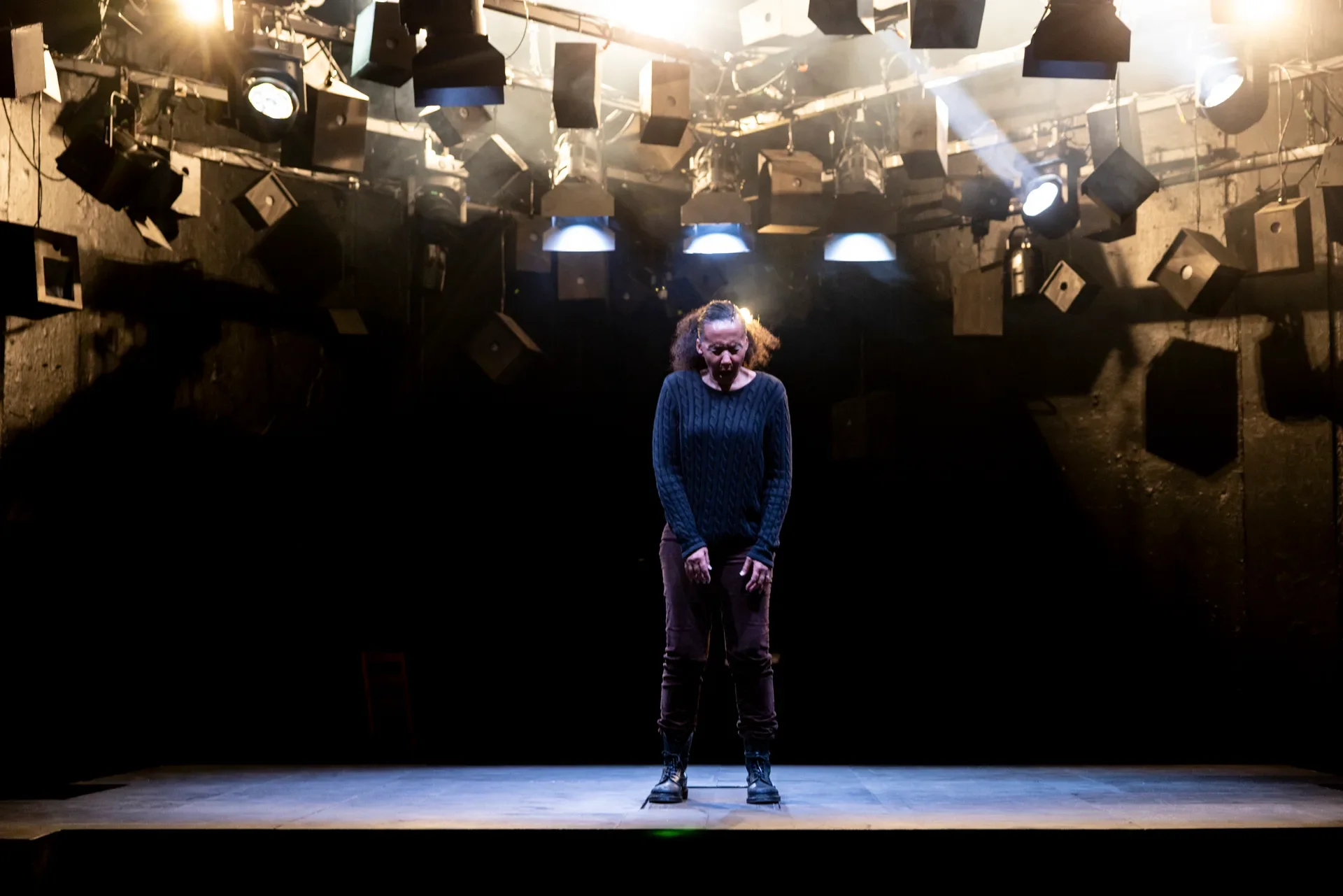
Photo by Brett Boardman
THE BIRDS
By Aden Zaki
It is no secret that our world is inching closer toward ecological collapse every day, and it is no secret that this is our fault. The price of human expansion has been the destruction of our environment and the prolonged extermination of almost every species with whom we share this planet. In Australia alone, almost 10% of land mammals have been wiped out since European settlement. But what if nature decided to launch a counterattack, and from the least likely of places?
This is the question that Belvoir St theatre’s latest production The Birds prompts us to imagine. Adapted from Daphne Du Maurier’s Gothic short story of the same name (also the inspiration for Hitchcock's classic film) this theatrical rendition by Louise Fox premiered at Melbourne’s Malthouse Theatre and is now playing at Sydney’s Belvoir. Under the direction of Matthew Lutton, award-winning actress Paula Arundell captivates in a one-woman performance that is as macabre as it is thought-provoking.
The show begins by introducing us to Tessa, Nat, and their two children, average city folk who have managed to escape the chaos and danger of urban life by retreating to a quaint seaside town… or so it seems. One night there is a change of wind and winter seems to have come early. The townsfolk are unbothered but Tessa notices that it seems to be having a strange effect on the birds; all of them have become inexplicably aggressive, attacking and swooping without provocation. One night she is awoken by a knock at her window; as she opens it a barrage of avian invaders flood the house, attacking the family with violent disregard. It is clear the birds are willing to sacrifice everything, even their own lives, to exact some kind of revenge. And this is only the beginning.
Daphne Du Maurier wrote The Birds in 1952 in the aftermath of two World Wars and at the cusp of a brewing Cold War. While the story is overtly critical of environmental destruction, it is also clearly a response to the anxiety of perpetual conflict characteristic of its time. Gothic art is always a response to burgeoning anxieties in the culture that produces it (recall the trope of the Vampire, a manifestation of Victorian puritanism and xenophobia following rapid expansion of the British Empire) and this adaptation is no exception to the rule. In the conflict between the birds and the family who have invaded their habitat, it is hard not to see resonances with our current geopolitical environment, shaped as it has been by imperial imposition and violent resistance. Instead of forcing us to take a side in the conflict, The Birds exposes us to the cruelty inherent to both, keeping audiences in a perpetual state of rumination.
This perspectival ambiguity is complimented by the haunting atmosphere cultivated by the production. The first thing you notice when you enter the space are the black birdboxes hanging from the ceiling, portents of what is to come. Then the raised wooden platform in the centre of the stage, which represents the domestic interior of the family home. The abstract set is contrasted by the realist props, an eclectic assortment of household goods from colourful doona covers to a fishing spear. These help to ground the surreal action in a sense of materiality, raising the stakes by bringing the action closer to home.
The light and sound are also appropriately anxiety-inducing. The show begins in total darkness before a flickering light illuminates Arundell’s face from below, giving her opening monologue the feel of a campfire horror story. The most striking moments of light and sound, however, are the bird attacks. With every swoop comes a disorienting flash of light and a deafening squawk. Again, these abstract representations are grounded by Arundell's performance, through which we can feel every scratch and graze. At all levels of this production the material meets the abstract, mirroring the dissonance between the ordinariness of the family and the surreal terrors they face.
The show’s success is due in large part to Arundell’s impressive performance. She maintains a relentless energy throughout the full 80 minute runtime and deftly transitions between characters without fault. I felt the directorial possibilities of the one-person performance were not fully realised (there are no intentional ambiguities in character transitions, no deliberately prolonged transitions, no moments where multiple characters speak through the actor simultaneously), however there were certainly some evocative moments. One that stands out is when Tessa pleads helplessly to her husband for guidance and his metaphorical absence is made literal by the lack of his character’s presence on stage. Aside from being technically impressive, the solo performance contributes to the show’s uncanny atmosphere by rendering the family’s isolation palpable.
The Birds is an evocative rendition of a Gothic classic that does not shy away from leaving its audience in a lingering state of disquiet. It will have you biting your nails while you are in the theatre and thinking about it long after you have left. Through its unflinching depiction of a threatened population driven to remorseless violence, it forces us to consider the parallels between our dominion over nature and our domination over each other.