
By Lola Kate Carlton
Edited by Raven Carlton
The murder mystery genre is a cornerstone to the world of theatre. A money-maker; selling out shows to crowds who generally know what they can expect. This is to say it can be both entirely stereotypical, and deeply comforting in turn. Ensemble Theatre tends to avoid the humble murder mystery where they can, leaving it to smaller theatres. So, it was a surprise to see Dial M For Murder grace Ensemble’s stage. In this smoky, complicated, love triangle-filled, almost-murder mystery, we witnessed both what shines through about the genre, and what makes it so difficult to master.
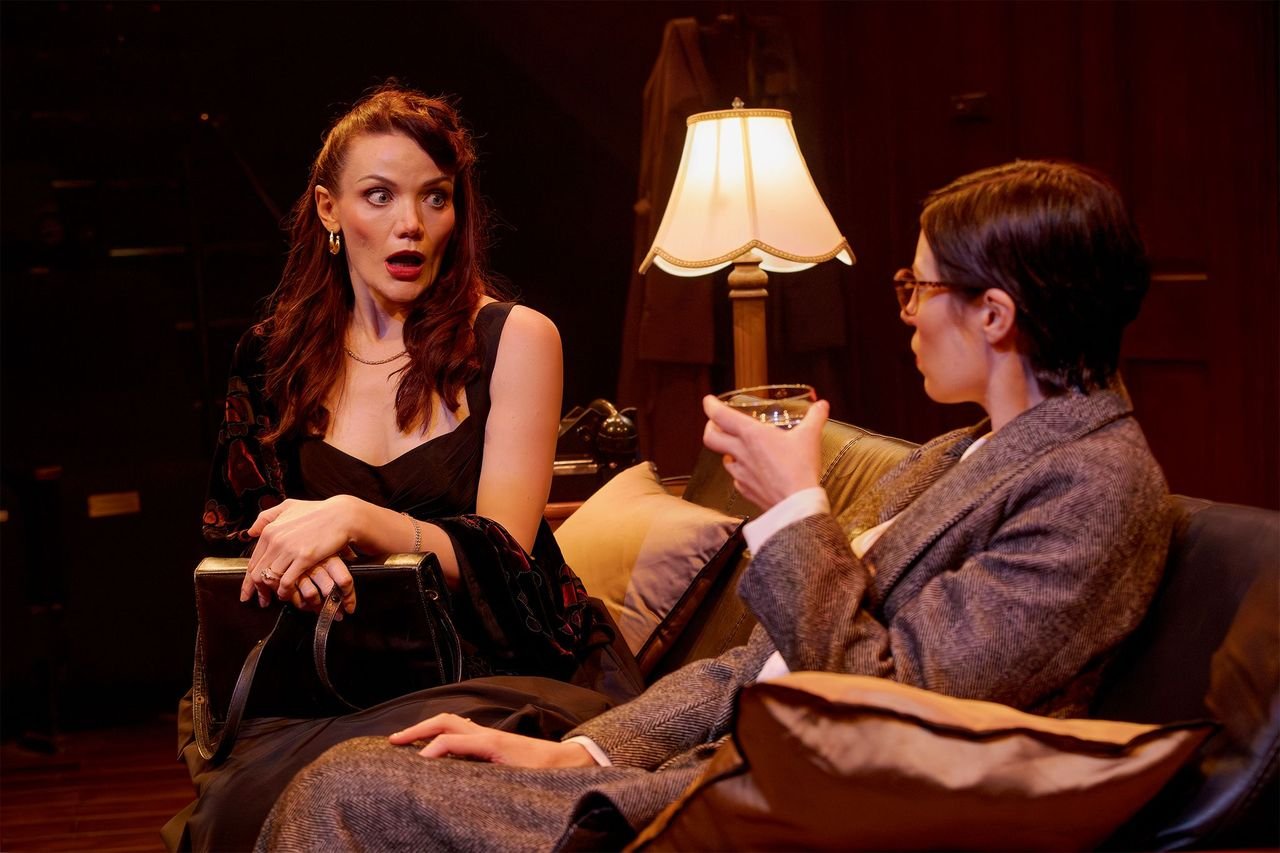
Ensemble Theatre is well known for its production value, and Dial M For Murder was no exception. Upon entering the space, the richness of the set immediately jumped out. Director Mark Kilmurry has expertly presented us with a world that grounds the audience through the stakes and drama of the piece’s action. Warm toned wooden browns and deep, luscious reds littered the room in a beautifully naturalistic 20th century apartment. Congratulations in this regard must be given to Nick Fry, who soared above and beyond in both costume and set design. On the wall sat the abstract interpretation of Yeats’s Leda and the Swan by Jerzy Hulewicz, which told us this may be a story we’ve heard before, yet in an entirely new way. It also hints us into the action of the piece — a woman overpowered, a godlike figure turned animalistic, an innocence betrayed. Both of Ensemble’s theatres are thrust theatres, which center the audience’s focus entirely on the action from three separate angles, while simultaneously creating a feeling of intimacy that can sometimes be lost in rooms of this size. This proved to be necessary as the relationships of this play got more intimate, and infinitely more complex.
The play opens on two young women, Margot Wendice (a married woman), played by Anna Samson, and her paramour Maxine Hadly, played by Madeline Jones, setting up the play’s first complex relationship. Margot’s husband, Tony Wendice, played by NIDA graduate Garth Holcombe joins us as our murderer, seeking revenge on his wife for sneaking out on him by plotting her death (which would also conveniently leave him access to her fortune) and utilising letters from Maxine as forms of blackmail. Thus, the second complex relationship is formed. Tony Wendice does not act alone, however. He enlists schoolyard-playmate-turned-vagabond, David Soncin, dangling further blackmail over his head to inspire him to act. The cast is rounded out by Kenneth Moraleda, as the Inspector, who, perhaps, is the only unconnected party.
My stand out of the night was Holcombe, who presented a genuinely menacing yet deeply charming villain, especially through his presence and physicality on stage. Although I found his vocal choices through the first half somewhat confusing — they leaned almost musical in their range rather than going for a steadier delivery — this issue smoothed over for the most part in the second act. Particularly strong moments for him were his scene conspiring with Soncin, (who I was convinced he was going to kiss), and his quick, brilliantly insincere emotional shifts depending on who was in front of him. I did truly want him to get away with it all. Samson gave a sophisticated portrayal of an aristocrat, even in her moments of struggle and panic. Her vocal work was generally strong, and her emotional work in the back half of the play was interesting. Through the front half, she struggled in moments to connect to the other actors on stage, particularly with Hadly, which made the believability of their relationship suffer. However, her physical work at the end of the first act, and emotional deterioration through the second act were effective. Hadly, in turn, gave us a witty and earnest portrayal of a New York City tragic artist, although wrestled with the same issue of connection that Samson did, and her accent work leaned slightly into caricature. Both Soncin and Moraleda were very strong, both understood the genre they were acting in, and I left the theatre wishing I had seen more of them. Across the board, all had solid moments of grief and emotion, but I was looking for stronger relationships and a more deliberate use of pause and timing — apart from Moraleda, who I felt was very comfortable in the comedy of the piece.
Murder Mystery is a genre that requires quite a significant amount of detailed preamble and exposition, which often slows down the first act. When trapped in context or specifics, it is often difficult to experience in-the-moment emotions. This, unfortunately, was exacerbated by the play’s exploration of relationships. Although the complex web of lovers did heavily aid the drama in the back half of the show, the first half had much of the world-building to slog through, which weakened the experience. This, ultimately, is an issue belonging to the Murder Mystery genre itself, and although frustrating, fingers cannot be pointed onto cast or crew for causing it. However, in the final moments of the first act, fight choreography by Scott Witt masterfully snapped the audience back to attention, which was significantly elevated by a connection to in-the-moment action from both Samson and Soncin. This was particularly effective in their use of sound — too often in stage-fighting we forget that we make noise when things hurt — but Samson delivered a truly nerve-wracking performance in her stunted breathing through the entire scene.
The second act picked up speed considerably, now that the audience was up to speed, we could figure the mystery out alongside the actors on stage. The emotions of the piece finally had a chance to feel the limelight, and we got to see all the relationships in the play stretch and shine. Lighting and sound both made much more interesting choices, praise here must go to Matt Cox and Madeline Picard. Further, makeup and costume was particularly impressive in the back half — the reveal of the bruises around Margot’s neck being a bonechilling moment. We also got to see each character think through their situation and choices more, with them being forced to make high pressure decisions very quickly. There were moments of physical melodrama which I felt took away from the presented naturalism, and the struggle in creating relationships in the first act meant that many of the climactic emotional moments in the second fell slightly flat. However, overall, the piece significantly improved through its latter half, which hints perhaps that this may have also been the nerves of opening night affecting its front end. Indeed, the moments of moral consideration — especially when Maxine attempts to bribe Tony — were incredibly interesting, and left me wishing for more exploration into how the complexities of the play left no true innocent standing.
For such a popular genre, the humble Murder Mystery is surprisingly difficult to execute. It requires stakes without melodrama, connection with grave consequences, and usually an entire act of world-building before anyone can have any fun. Director Mark Kilmurry has presented a strong example of the genre, and has done so through expanding on the elements that make it genuinely enjoyable and interesting. Dial M For Murder, despite falling into some of these common traps, presented a production that made up for its shortfalls in spectacular production value, and a very strong second half. It also leaves its audience with a question many in the genre are too afraid to ask — what is a legitimate motivation for murder?
‘Dial M for Murder’ is playing until the 11th of Janurary at the Ensemble Theatre.