
Language & Belonging in English at the Seymour Centre
By Lola Carlton
In a time wracked by white supremacist ideals, where English isn’t only a language - but rather a cultural signifier, a representation of status, and often a ticket to freedom, OutHouse Theatre Company has carved out a raw and introspective gem that puts the white western world’s noses in the ancient relationship between language and belonging.
When I tell people I lived in Italy for only three short months, they assume the entire thing must’ve been utterly glorious, a real La Dolce Vita every single day. But honestly, the thing I felt the most was lonely. I’m an okay Italian speaker, but for a long time I was a professional speaker in English. And the thing I found the most jarring was the fact that in Italian, none of my actual personality existed. As an English speaker, I get to be funny, charismatic, interesting, intelligent. But in Italian, the thing I was the most was awkward and stupid.
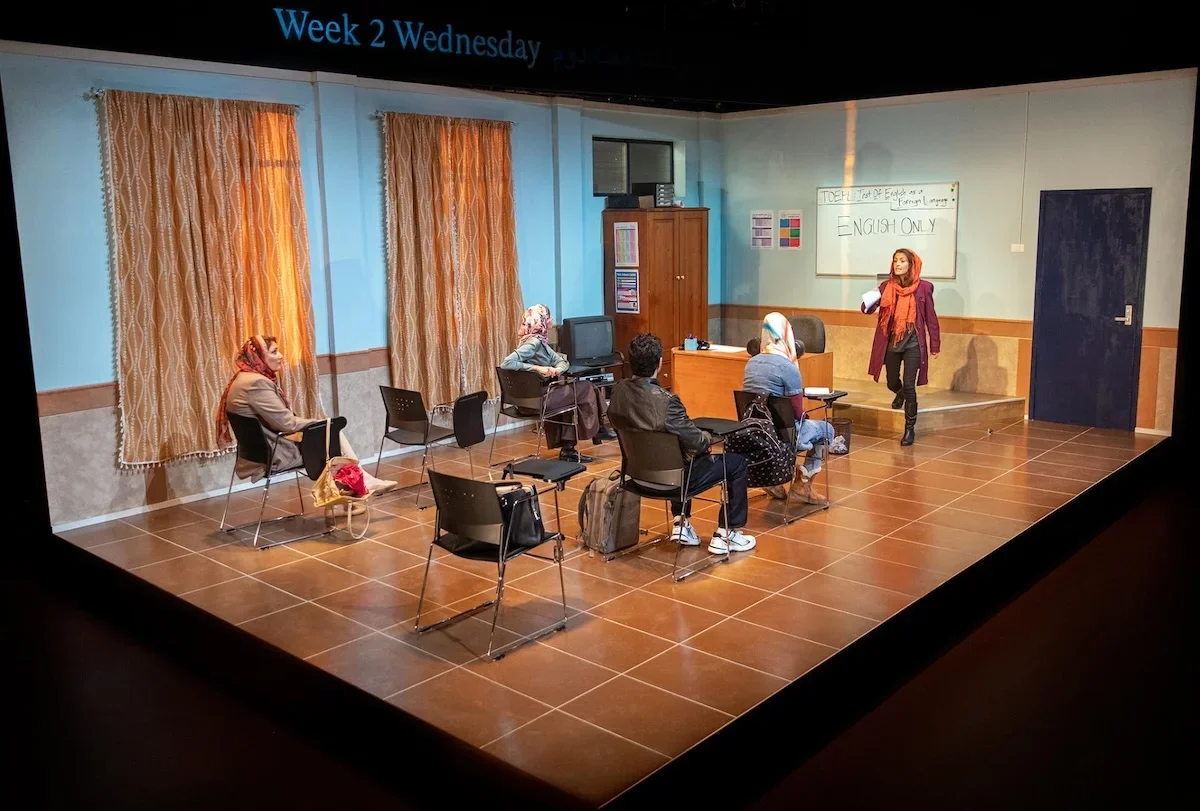
This is obviously a very bland and trivial comparison to the story of the play, but it did allow me to understand the conversation around the isolation of language in a very personal way. English is set around a group of students whose mother tongue is Farsi, (a Persian language spoken mainly in Iran, Afghanistan, and Tajikistan) attempting to pass the TOEFL (Test Of English as a Foreign Language). The four students all have their own unique motivations for staying (or not staying) in the classroom, and teacher Marijan leads them all towards reshaping their tongues, their mouths, and their voices to fit the ever difficult, ever changing language of English. If they learn it, their lives might change in incredibly significant ways. Passports, universities, freedom - but the more they speak it, the more they begin to feel their native language begin to slip through their fingers. In English, they can be anything. But only in Farsi can they actually be themselves.
The script is, obviously, fantastic. By writer Sanaz Toossi, it weaves together an intricate web of loneliness, desire, desperation, change, and control in a way that makes it so no one is really right or wrong. This allows the conflict that shapes the story to be so deeply human you cannot help to be swept up in it. The arc each character moves through feels perfectly moulded to them, and you are never left wanting more. Nothing in English overstays its welcome.
The performers are also all, individually, brilliant. Pedram Biazar as Omid takes us into the mind of the hollow over-achiever, desperate to belong but so beyond everything around him that his attempts to connect never quite land home respectfully. Setareh Naghoni is incredible as the strong willed Elham, always technically correct but never able to balance that need with necessary gentleness - and certainly, as a white audience member, one of the more confronting characters. Neveen Hanna is the soft but not delicate Roya, who is only attempting English to connect - and whose final moment of defiance lays the necessary groundwork for the rest of the play. Minerva Khodabande as Goli injects the play with the uplifting moments of comedy it very much needs to survive, and feels like maybe the only character who is learning English for not the right reason, but a reason unbothered by the unfortunate ugliness of necessity, desperation, or the creeping limbs of colonialism.
But it is Nicole Chamoun as Marijan who truly owns the stage. Chamoun seeps with charisma and presence, and has an undeniable talent for emotional storytelling that perhaps has not been seen to quite that level on Sydney stages. Perhaps it is her obsession with the language, or perhaps it is simply her skill that draws the audience ever-closer to her perspective, even as we see the cracks in it. Both her moments of whip-crack comedy, and her deeper moments of tragedy were immensely moving, and the final conversation of the play left nigh a dry eye in the house.
Production design was also on its A-Game. The set design of the classroom was just naturalistic enough to ground the production, costume breathed life into each and every characters’ personality, and a special shout-out must go to lighting, who dutifully waited until the women on stage had perfected their hijabs before allowing us to witness them again - an incredibly special touch to an already fantastic production.
My only, very minor frustration to what was almost a perfect show, was a simple adjustment in tempo. Emotional moments - especially at the ends of scenes - needed a moment to breath and hit the audience before the lights went off. For such a fast paced piece that completely enraptures its audience, it can afford to take slightly more time. Around important lines, there were moments I wanted just a touch of emphasis to bring what was being said into the light a little more. These issues are extremely common with one act shows in their anxiety to not keep the audience sitting down for too long - but I would much rather a show happen too quickly than a show with a bad habit of dragging us unwillingly along behind it.
What is language if not a way to express who we truly are? What is identity if not another way to find belonging? And what are our names, if not a way to connect with our deepest self? English takes every one of these intimate questions and wraps us up in a whirlwind of completely contradicting answers. Led by a brilliant team of performers, directors, and creatives, this show will find a way to connect with you no matter who you are. In a time where we find ourselves further and further away from ourselves, and certainly further away from each other, it is theatre like this that forces you to reckon with who you are and why you are, that will bring us all back to some sense of sanity.