
By Lola Carlton
Hollywood’s Favourite Catfight: Bette & Joan
“You should never say bad things about the dead, you should only say good. Joan Crawford is dead. Good.”
Bette Davis and Joan Crawford, for some of this illustrious magazine’s younger readers, were not only enemies, not only loathed each other, but were the fundamental blueprint for every single celebrity rivalry that has been since. As titans of early Hollywood, defining what filmmaking was and would be for the rest of its glittering history, competition was ultimately inevitable. And yet, Bette Davis and Joan Crawford didn’t just have friendly, professional competition. No, these women despised each other in a way that has defined them both even in death. But why? Both of them were incredibly talented, both of them were famous in their own right, and both of them left behind significant legacies. Such is the delicate question that Bette & Joan at The Ensemble Theatre answers.
Hollywood has never been a comfortable place for women, especially as they get older. Meryl Streep, which many would consider one of the greatest actresses of all time, and certainly one of the greatest working actors of the current era, was offered three witches after turning forty. Aging is not just an existential threat for the women of the silver screens, it is an ever-encroaching reality that erodes their fame, their relevance, and their job opportunities - and even famous people have to buy groceries. This was even more true for the women of the “Golden Age of Hollywood.” Turning 30 was disastrous. And fame was too young and too hungry to feed you for long after you left the public eye.
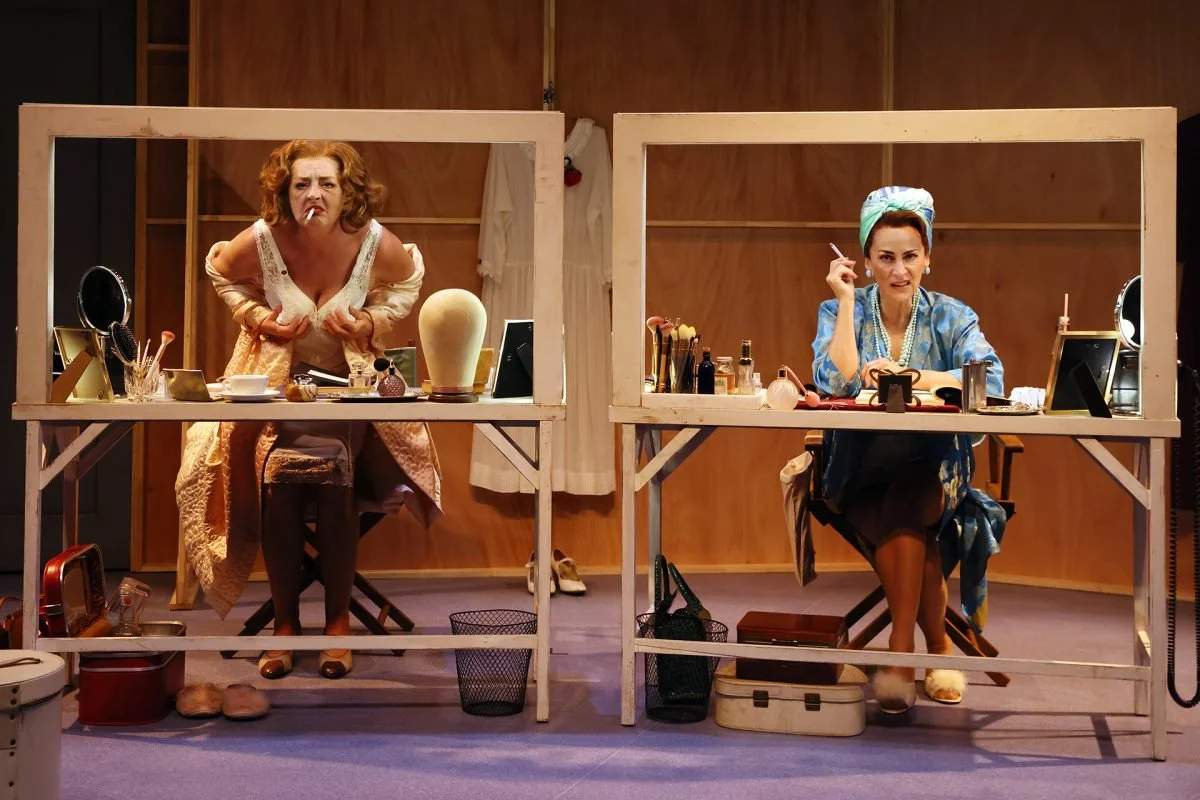
Tucked into the intimate setting of the Ensemble Theatre, we see two dressing tables, just in front of what looks like the back of a traditional flat. The stage is otherwise bare. Joan Crawford enters, played by Lucia Mastrantone, and begins what will unfurl as a masterclass of character acting. Mastrantone utterly embodies silver screen glamour, giving the audience a cunning and clashing mix of insecure and magnificent. It would undermine her performance to call it naturalistic, and so I would instead find myself describing her performance as something straight out of a Tenessee Williams play; Blanche-Dubois-ing her way into empathy from the audience. Her razor-sharp humour carries us all the way into the introduction of the other half of this bubbling equation, Bette Davis portrayed by Jeanette Cronin. Cronin is similarly incredibly charismatic, and with a grounded “what about it?” nature that was refreshing not only in Davis’s own time, but once again in ours. As a performer, she shined in her more subtle moments, anything to the smallest twitch of her hand drawing us in closer to her. Physical humour came out swinging in the second act, which beautifully contrasted with the somewhat depressing reality that these women weren’t too dissimilar, and may have actually liked each other without the oppressing, cloying weight of an industry that forced them into bitter rivalry. 1950s politeness versus bullwhip vintage insults begin to battle it out on stage, as these women come
face to face with the realities of working together, in something not quite biographical, but not too far from farcical either.
On a design level, the production continued to impress. Intermittently through the show, projections of interviews would cast up onto the “back” of the flats facing us, creating a dialogue between these women’s public persona, and the persona they were gleefully or nervously allowing us to witness. Like a noir film, we watch these women transform, or refuse to transform to fit their “public.” The script, although perhaps “slow” for a modern audience, was incredibly clever and funny, taking us into a level of intimacy that felt at times almost uncomfortable to witness. Lighting and costume combined brilliantly into moments that snapped between a scrutinising level of immodesty, and a glamorous blanket of warmth and fur. Even in places where the production felt “cheap” (a.k.a. Joan Crawford bright blue pearls) one couldn’t help but think that it must’ve been done on purpose, to let us in on the secret that nothing is quite as magnificent as it seems.
As we face the women of fame in the modern era and their calamities, the Chappel Roans, the Charlie XCXs, and even, god forbid, the Emerald Fennels, it is productions like Bette & Joan that allow us to interrogate why the systems that we built to contain and cage female talent have survived for so long. Why do we still find ourselves instinctively hunting for male validation, why do we allow the arts to strip everything away from us until we’re nothing without them, and why do we allow ourselves to exist with the ticking time bomb of “aging out” hovering so close to us? Told through two of the strongest performers on the Sydney stages, Bette & Joan reveals the horrible secret behind these questions: we may respect the women we are forced to compete with, but it’s much easier to weaponise the system against them than it is to allow them to win next to us. Fame, after all, is society’s favourite superiority complex, and none of us truly realise we’re not as untouchable as we think we are, until we’ve already lost touch completely.